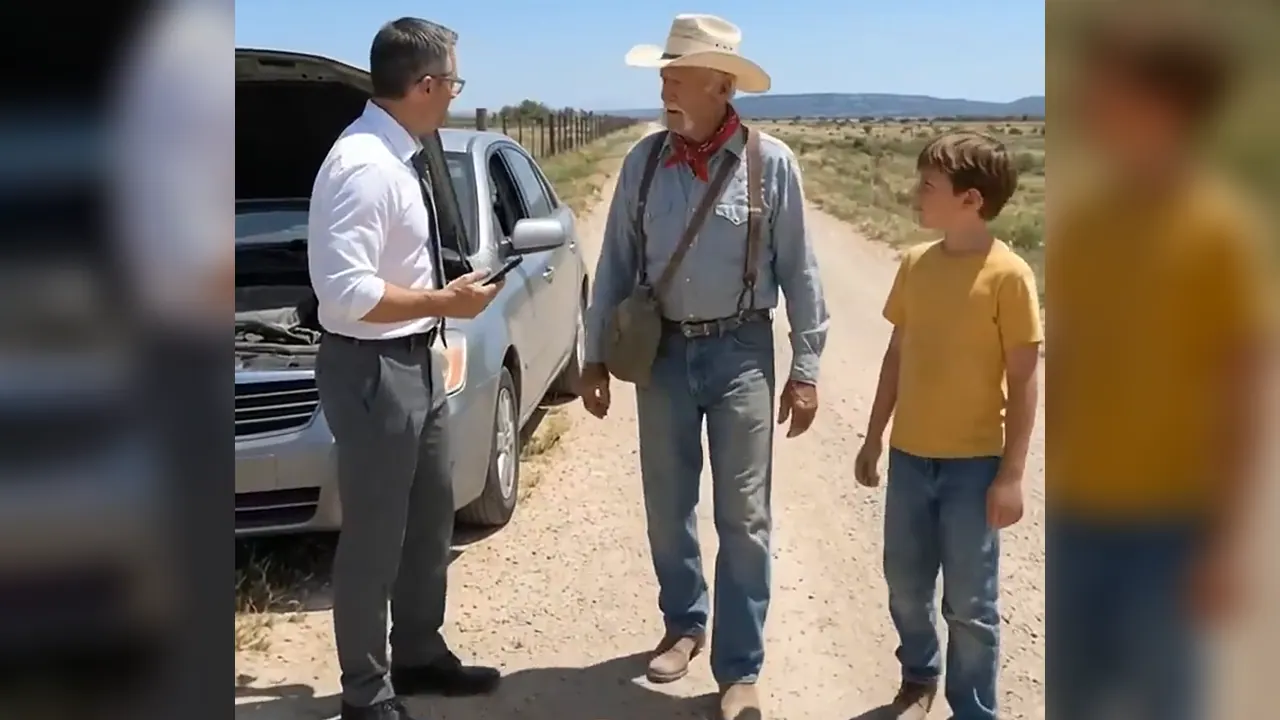
An Unexpected Encounter Along An Empty Country Road
Bright sunlight beat down upon a long gravel road stretching through the desert terrain.
A modern silver sedan sat parked along the shoulder with its hood propped open.
Steam rose quietly from the compartment while a man in business attire paced nearby.
He wore a crisp white collared shirt, dark trousers, and a neatly tied necktie.
The stranded motorist lifted one hand to shield his eyes against the midday glare.
He glanced repeatedly at a mobile phone displaying no available network signal.
Two figures walked steadily along the center of the dusty road toward the car.
An older man wore a faded denim work shirt, suspenders, and a pale cowboy hat.
A red bandana rested loosely around his neck above his buttoned blue shirt collar.
Beside him walked a young boy dressed in a yellow shirt and blue jeans.
A round canvas canteen hung securely across the older man’s shoulder by a strap.
Both travelers paused in the road to observe the disabled vehicle and its driver.
The older man pointed toward the dry radiator compartment beneath the raised hood.
He explained that the nearest settlement was roughly forty miles down the rural route.
The stranded driver sighed and admitted that his mobile telephone carried no reception.
He explained that he had remained beside his vehicle for three full hours.
Sharing The Final Drop Of Well Water
The young boy reached out and touched the sleeve of the older man’s shirt.
He pointed toward the canteen and noted that very little water remained inside.
Six miles of open walking still lay ahead along their dusty route home.
The older man looked down at the boy and offered a quiet correction.
“Water is not ours to keep,” he said.
He unscrewed the metal cap from the canvas-wrapped flask with careful hands.
Extending his arm, he offered the open container directly to the parched motorist.
The driver accepted the flask and drank several deep swallows beneath the hot sun.
He wiped his mouth and expressed surprise that strangers would surrender their supply.
The man in the tie asked who actually owned the surrounding desert property.
The older man explained that distant investors held legal rights to the territory.
He mentioned that commercial interests planned to exploit the local subterranean water source.
The motorist listened closely while studying the rugged terrain around the unpaved roadway.
He handed the canteen back, but the older man pushed it gently away.
The older traveler insisted that the driver keep the flask until help arrived.
Turning around, the elderly resident and the boy resumed their quiet journey homeward.
The driver stood by his open car, watching them walk down the road.
The afternoon heat continued to shimmer across the flat plains behind their backs.
An Unwelcome Visitor Arrives At Sunset
The golden light of dusk settled over an old homestead later that evening.
A tall metal windmill stood quietly beside a broad corrugated steel stock tank.
The older man and the boy walked through an open wire gate together.
A stocky man wearing a blue polo shirt stood waiting near the house.
The visitor held a large brown leather document binder firmly under one arm.
He stepped forward along the dirt pathway to intercept the returning ranch residents.
The man in blue declared that paperwork regarding the land purchase required review.
He wanted terms finalized before signatures were placed upon the official transfer contract.
The older man paused beside the circular tank filled with cool clear water.
Several large blue plastic storage containers stood arranged along the sandy soil nearby.
The resident pointed out that multiple local families relied entirely on that well.
He asked where neighboring households would find water once corporate drilling commenced.
The visitor shrugged his shoulders and replied that market profits decided such outcomes.
He stated bluntly that bottled water held more commercial value than open cattle tanks.
With a dismissive gesture, he placed the heavy folder upon the metal gate.
He walked away toward his vehicle, leaving the residents alone by the fence.
Quiet Discussion Inside The Wooden Farmhouse
Night fell over the plains, casting deep shadows across the small wooden home.
A single warm electric lamp illuminated the modest interior of the ranch kitchen.
The older man stood beside a white porcelain sink beneath a curtainless window.
He lifted a clear glass pitcher and poured drinking water into a tumbler.
The young boy sat quietly at a heavy rectangular wooden table nearby.
Both of the child’s hands rested firmly around an unpainted metal cup.
The boy looked up toward his guardian with an expression of quiet concern.
He asked where they would go if the proposed contract remained completely unsigned.
The older man walked slowly across the linoleum floor carrying the filled glass.
He set the glass down upon the weathered surface of the dining table.
Pulling out a wooden chair, the elder sat beside his young family member.
He rested one weathered hand over the boy’s arm in a supportive gesture.
The man stated that he would never surrender water needed by neighboring families.
The light from the window revealed the distant outline of the silent windmill.
A Confrontation Beside The Steel Fence Gate
Bright daylight returned to the ranch property on the following clear summer morning.
The older man and the young boy stood side by side behind the fence.
The man in the blue shirt returned and stood outside the closed gate.
He looked at his wristwatch and announced that contractors were approaching the property.
The representative stated that a drilling crew planned to seal the well at noon.
He instructed the resident to pack his personal belongings and vacate the premises.
The older man placed one hand against the rim of the stock tank.
The boy picked up a large blue water container from the dry ground.
Stepping forward, the elder made it clear that he intended to remain right there.
He declared that work crews would have to build over him directly.
The agent patted his folder and reminded the rancher of his tenant status.
He claimed that corporate owners in a distant city had already approved the operation.
The representative gestured dismissively toward the horizon as if the issue were settled.
The older resident refused to open the gate or step away from the tank.
Both sides maintained their positions under the clear expanse of the morning sky.
Tension lingered across the dusty ground between the house and the access road.
The Stranded Driver Makes An Unexpected Return
A second vehicle approached the ranch gate and came to an abrupt stop.
The man from the broken car stepped out into the open morning sun.
He still wore his white business shirt, black tie, and rimless reading glasses.
In his right hand, he carried the old canvas canteen by its strap.
The agent in the blue polo shirt turned around in visible surprise.
He adjusted his posture quickly and addressed the newcomer with formal respect.
“Mr. Whitaker,” the agent said politely.
The corporate representative smiled broadly and attempted to present the pending land contract.
He emphasized that finalizing the water bottling agreement represented a substantial financial windfall.
The newcomer looked down at the leather folder and shook his head firmly.
He announced that he had not approved any paperwork and rejected the proposal.
The executive revealed that the elderly rancher had saved him along the road yesterday.
The older resident took off his hat and wiped his brow in surprise.
The executive walked toward the fence and confirmed that the well remained protected.
He stated that full water rights belonged permanently to the surrounding local families.
Kneeling down before the gate, the executive handed the canteen back to the boy.
The child accepted the flask with a proud grin across his face.
“Water is ours to pass along,” the boy said softly.
The Meaning Behind This Desert Encounter
The recorded drama effectively illustrates how small acts of hospitality can reshape unforeseen outcomes.
Each character’s role reflects contrasting attitudes toward natural resources and community survival in rural areas.
The visual contrast between the arid desert road and the working windmill underscores the central theme.
Careful pacing allows the quiet interaction between travelers to gain importance during the later confrontation.
The simple canteen serves as a clear physical reminder of the assistance previously offered.
Viewers can easily follow how the narrative connects isolated road trouble with corporate decision-making.
This production presents a fictional cinematic story designed to dramatize rural water conservation and personal ethics.
When encountering stranded vehicles in extreme heat, motorists should contact local highway patrol or emergency responders.
Carrying extra drinking water, roadside flares, and a reliable communications device remains essential during remote travel.
The main figure begins as a helpless motorist stranded under the desert sun and concludes as a decisive benefactor protecting the local community.
Share this with someone who still believes that doing the right thing comes back around.