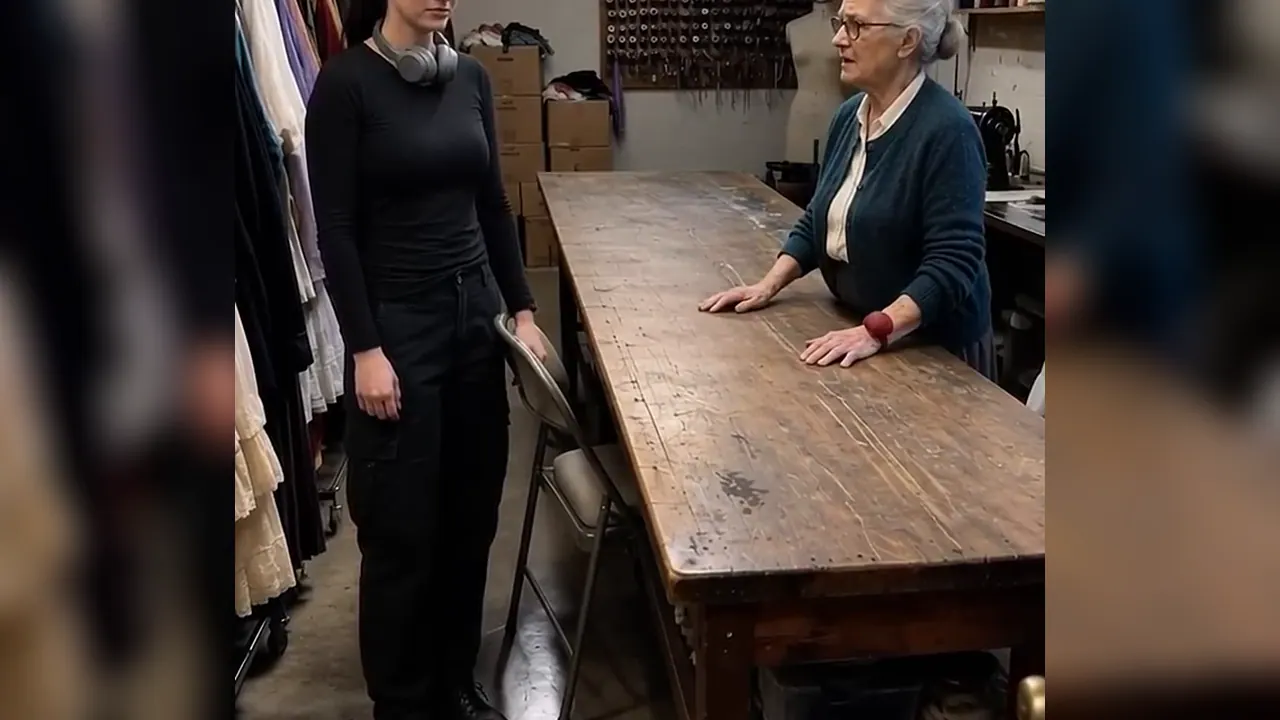
A Dismissal Inside The Costume Workshop
Fluorescent lights hummed above long wooden worktables inside the basement wardrobe department.
Racks of theatrical garments lined the exposed brick walls of the quiet storage space.
An older woman with silver hair stood beside a large cutting table.
She wore a dark patterned skirt, a green knitted cardigan, and wire glasses.
A younger woman dressed entirely in black stood across from her holding a clipboard.
Headphones rested around the younger woman’s neck as she held up a round tin.
Suddenly, the younger woman declared that the old tin belonged in an exhibition.
She announced that automated sewing machines would handle all repairs from now on.
The older woman rested both hands against the smooth wood of the table.
She was informed that her new assignment would involve sorting through used donations.
“Donations?” the older woman asked quietly.
She noted that nobody had inspected the contents of the metal box yet.
For over four decades, she had maintained garments without a single seam failing.
The younger assistant wrote notes onto her clipboard without pausing her brisk lecture.
She insisted that mechanical stitching produced faster results for the upcoming production.
She ordered the older seamstress to stay away during Friday’s opening performance.
An Encounter Near The Stage Alley
Outside the stage entrance, wet pavement reflected yellow light from an exterior wall fixture.
Moisture coated the brick walls of the alleyway under the dark night sky.
The older seamstress carried her metal tin down the concrete steps toward the alley.
A man wearing a brown work jacket sat alone upon a wet wooden bench.
He stood up when he noticed the woman walking past the brick doorway.
“Is this the stage door?” the man asked.
He pointed toward a torn seam exposed along the shoulder of his jacket.
He mentioned having an important meeting scheduled in less than ten minutes.
The seamstress observed the torn fabric and stopped beside the dark bench.
She noted that nobody should enter through the stage entrance with damaged clothing.
She walked toward the wooden bench and set her round tin on her lap.
The man sat down beside her on the bench under the cool mist.
She removed a needle and a spool of bright red thread from the tin.
“Sit still,” she said softly.
She pulled a long strand of red thread through the narrow eyelet.
She assured him that ten minutes provided enough time to complete the task.
A Quick Repair Under The Rain
The man smiled as the older woman began working carefully along his shoulder.
He asked if she always traveled with a complete assortment of mending supplies.
Her hands moved rhythmically as she pulled the red thread through the coarse fabric.
She tied off the seam securely before cutting the remaining length of thread.
The man inspected his repaired shoulder and reached into his pants pocket.
He pulled out a paper bill and offered it toward the older woman.
“Let me pay you,” he said.
The older woman shook her head and closed the lid of her tin.
She told him to put the money away before she took offense.
She gently guided his hand back toward his side with a calm touch.
She explained that red thread signified that a person mended the garment with care.
The man looked at his shoulder and thanked her for her unexpected assistance.
He asked if he would see her working backstage during Friday’s opening night.
She answered that Friday’s attendance was no longer within her control.
She watched him hurry through the stage door before she turned away.
Emergency Repairs In The Theater Corridor
Bright dressing lights illuminated a narrow backstage corridor filled with costume racks.
The same man now wore an elaborate dark green velvet eighteenth-century theater coat.
A large white tear gaped open along the left sleeve of his coat.
The young assistant held a wide roll of silver duct tape beside him.
She suggested pressing the tape along the inner lining of the damaged velvet sleeve.
She claimed audience members seated beyond the front rows would never notice the tape.
The lead actor pointed in disbelief at the tear under the bright lights.
He explained that the thick coat needed full mobility during active stage movements.
He insisted that duct tape would fail before the end of the second act.
He asked who used to sew the wardrobe for this theater company.
The assistant dismissed his question by describing an older woman with a cookie container.
Suddenly, the older seamstress entered the hallway holding her round metal box.
The assistant scowled and ordered the older woman to leave the building immediately.
The seamstress replied that she only came to return her building keys.
She looked directly at the torn velvet shoulder on the actor’s coat.
She remarked that the garment would never survive through the first scene.
A Demanding Lead Actor Takes Charge
The seamstress opened her blue container to reveal spools of colorful thread.
She explained that the split occurred because the machine stitching lacked adequate allowance.
She requested twelve minutes and a simple chair to fix the sleeve properly.
The younger assistant immediately crossed her arms and refused the older woman’s offer.
She claimed the older woman was not assigned to tonight’s active stage crew.
The actor stepped closer to the older woman and recognized her face.
He remembered the alleyway encounter and mentioned the red knot inside his jacket.
The assistant argued that the incident was merely an unimportant coincidence.
She warned that theater insurance rules prohibited non-staff members from handling active wardrobe.
“Then put her back on staff,” the actor demanded firmly.
He insisted the change happen immediately before the final five-minute curtain call.
The assistant hesitated while looking down at her official production clipboard.
The actor threatened to cancel his performance if the coat was not mended.
He declared that the curtain would stay down until she repaired the sleeve.
The assistant pointed toward the stage and protested the full audience waiting outside.
Restoring The Coat In The Wardrobe Room
The older woman returned to the wooden worktable in the basement costume room.
The lead actor stood upright while she carefully pinned the velvet shoulder seam.
The younger assistant stood silently in the background with her arms crossed.
The actor informed them that production leaders had approved the veteran seamstress’s contract.
He announced that she would manage the wardrobe department for the entire season.
He added that the assistant would now handle sorting through incoming clothing donations.
The older seamstress instructed the actor to stand still while she worked.
She noted that creating a proper red knot required a completely steady shoulder.
Her needle moved through the velvet fabric with smooth and practiced precision.
A short while later, the seamstress approached the younger woman sitting nearby.
The assistant sat on the edge of a table with tears visible.
The older woman extended a wooden spool wrapped in vibrant red thread.
She spoke gently about the meaning behind using red thread inside hand-stitched seams.
The assistant took the spool and admitted she had never learned hand sewing.
The older seamstress offered to guide her hands through each stitch.
The Meaning Behind This Theater Story
The dramatic conflict centers on the clash between mechanical speed and human dedication.
Small physical props like the cookie tin and the thread anchor each character’s motivation.
The sequence highlights how invisible labor often upholds entire artistic productions.
Every exchange between the three characters clarifies their differing values toward craftsmanship.
The visual contrast between sterile tape and durable thread emphasizes the main theme.
This video represents a scripted fictional cinematic story designed to dramatize professional workplace respect.
In working theatrical venues, sudden costume failures are typically managed through established union protocols.
Personnel disputes should always be resolved through professional management channels rather than ultimatums.
Wardrobe technicians are advised to maintain certified safety equipment and standard toolkits.
The older worker began the day facing total dismissal and ended it sharing her knowledge.
Know someone whose hard work often goes unnoticed? Send them this story.