An Unexpected Standoff Inside The Examination Room
Bright fluorescent light fixtures illuminated the plain gray walls of the institutional office space.
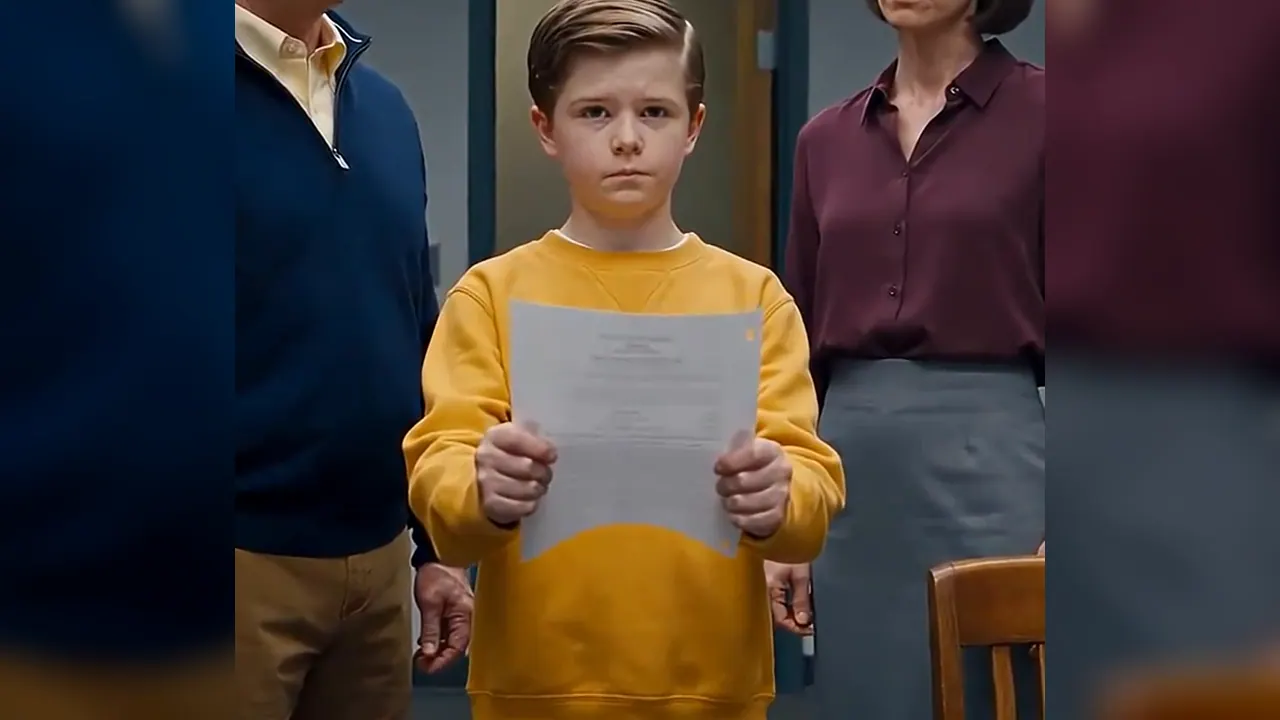
A young boy stood squarely in the center of the neutral carpeted floor.
He wore a mustard yellow crewneck sweatshirt over dark blue denim jeans.
Clean white athletic shoes rested side by side against the gray commercial carpeting.
To his left stood an older man dressed in a dark blue sweater.
A pale yellow collared shirt peeked out neatly from beneath the blue knit fabric.
Tan trousers and brown leather loafers completed the older man’s tidy, formal appearance.
To the boy’s right, a woman in a dark plum blouse stood upright.
She wore a tailored slate gray pencil skirt along with pale pointed high heels.
Her dark hair fell into a clean chin-length bob with blunt straight bangs.
A high-backed wooden chair rested on the floor just behind her right hand.
In the background, a closed painted door remained set into the smooth wall.
Suddenly, the woman shifted her weight and turned directly toward the young boy.
“You lost fairly,” she stated firmly.
Her left hand rested casually against the high curved back of the wooden chair.
She tilted her chin upward while addressing the quiet figure beside her.
The Presentation Of A Contested Sheet
The woman instructed the boy to stop questioning the final decision immediately.
Her facial expression remained strict and unsympathetic as she delivered her brief verdict.
The boy did not step backward or lower his eyes during the sharp reprimand.
Instead, he slowly raised his two hands in front of his chest.
Both hands gripped the bottom edges of a single white sheet of printer paper.
Small circular binder holes lined the margin along the side of the page.
Several rows of printed black text covered the side facing the boy’s eyes.
“Please check this before you dismiss me,” he said plainly.
His voice remained steady and polite without any audible trembling or anger.
The woman did not reach out to take the offered white document.
Her posture remained rigid as she looked across at the seated panel members.
“The decision has already been recorded,” she replied dismissively.
She looked away from the child and stared ahead toward the unseen judges.
Her tone suggested that the scheduled proceedings were officially closed for the day.
The boy maintained his grip on the paper without lowering his extended arms.
The man on his left turned his head to look downward at the paper.
Examining The Details On The Record
The older man in the blue sweater stepped half a pace closer to the boy.
He focused his gaze on the rows of printed text across the page.
His brow furrowed deeply as his eyes scanned the printed vertical lines.
He raised his right arm and extended a single index finger toward the sheet.
The man leaned his torso forward to point directly at a specific section.
“The final column was filled before your speech,” he noted aloud.
His tone carried an unexpected note of realization as he traced the markings.
The woman immediately turned her head back to look at the document.
Her lips parted slightly as her sharp expression gave way to sudden surprise.
The room remained completely quiet as the implications of his observation registered.
The boy kept the sheet balanced between his thumbs and fingers at chest height.
No one reached forward to take the piece of paper away from him.
The boy took a small breath and kept his attention fixed directly forward.
“Then the record needs another look,” the boy responded clearly.
He spoke without raising his voice or displaying any outward agitation.
His demeanor matched the formal atmosphere of the sterile hearing room.
A Direct Challenge To The Panel
The woman in the plum blouse stared at the boy with open shock.
Her fingers tightened slightly against the wooden rim of the office chair.
The man beside the child pulled his hand back to his side.
He straightened his posture while keeping his eyes fixed on the distant committee.
Both adults now seemed unsure of how to proceed with the formal dismissal.
The boy adjusted his grip on the paper with deliberate, measured movements.
He rotated his wrists smoothly to flip the document outward toward the front.
The reverse side of the white sheet became visible to everyone sitting opposite him.
The blank surface of the clean white cardstock reflected the bright overhead lamps.
Two round punched holes were clearly visible along the top edge of the sheet.
The boy held the blank paper firmly against the front of his yellow sweatshirt.
“Who decided our scores in advance?” he asked directly.
His question was addressed straight to the invisible table of presiding contest officials.
The woman’s eyes opened wider as she processed the child’s public query.
The man beside him remained motionless, watching the panel’s impending reaction.
Neither adult attempted to silence the young speaker or pull him away.
Unfolding Consequences Before The Committee
The boy stood perfectly straight with both feet planted on the gray floor.
His calm gaze never wavered from the people seated across the room.
The bright yellow of his sweater contrasted sharply with the gray surroundings.
The woman’s hand stayed anchored to the polished wood of the chair.
She seemed unable to find words to counteract the boy’s public statement.
The older man looked ahead with a stern and conflicted expression on his face.
The clean white paper remained held out for all observers to inspect.
The room stayed still as the participants waited for an official response.
No one moved toward the doorway in the gray rear wall.
The institutional light washed over the three figures standing together in front.
The paper served as undeniable evidence that challenged the fairness of the competition.
The boy lowered his chin slightly while maintaining his resolute physical stance.
The entire panel was left to address the documented irregularity in the open.
The camera captured the complete stillness that settled over the three presenters.
Every movement in the small room had come to an abrupt, expectant halt.
The brief scene concluded on the boy’s open inquiry into the official tally.
The Meaning Behind The Staged Contest
This dramatization draws its power from the sharp visual contrast between the characters.
A young child calmly facing authoritative adults creates an immediate and compelling dynamic.
The simple physical prop of a paper sheet focuses the entire narrative conflict.
Precise pacing and measured dialogue allow the viewer to register every subtle reaction.
The sequence highlights how composure can effectively counter arbitrary authority in institutional settings.
Viewers should note that this video depicts a fictional cinematic story created for entertainment.
In genuine academic or competitive settings, official challenges should always follow established grievance procedures.
Contestants and guardians should document irregularities calmly and submit written appeals through proper channels.
Maintaining composure and collecting factual evidence remains the most effective approach to dispute resolution.
The young boy begins the scene as an overlooked participant and finishes as the room’s central authority.
Share this with someone who believes that standing up for fairness always matters.