A Dispute Arrives At The Shoreline
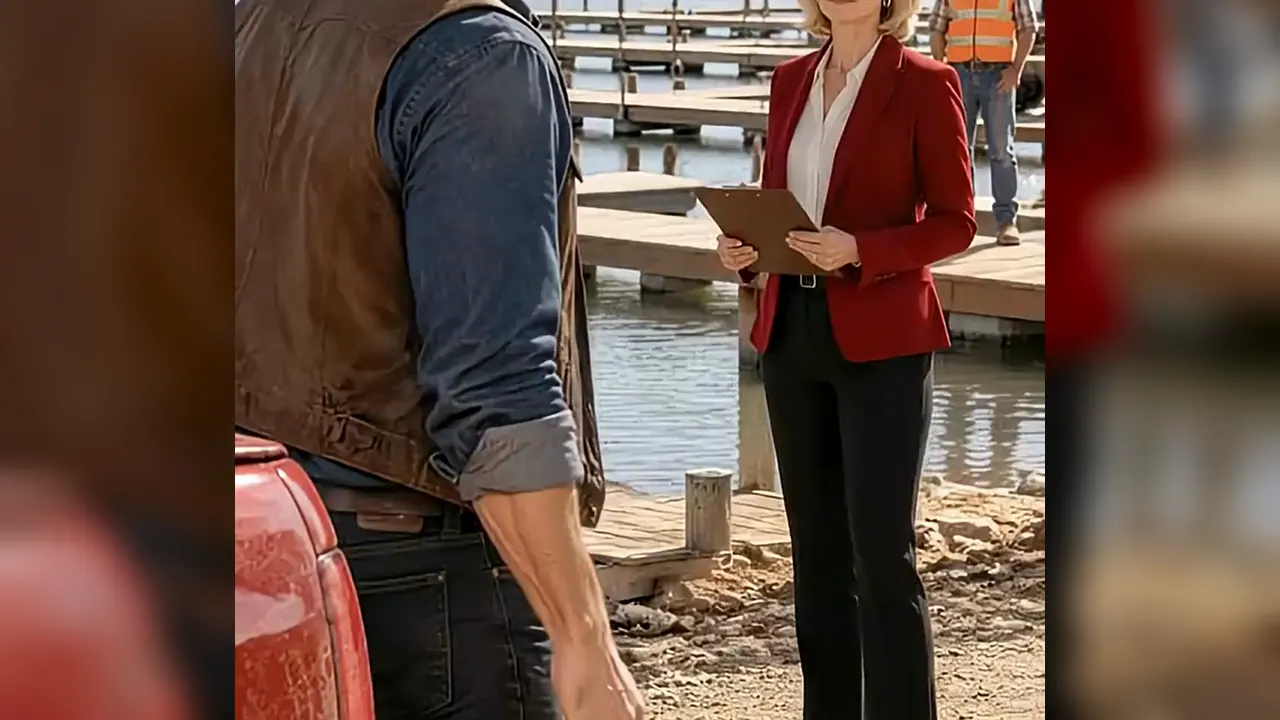
Bright morning sunlight shone across the wide, calm water of the rural lake.
A man wearing a brown leather vest parked his red truck near the dirt road.
Several wooden boat docks extended out over the shallow water near the shore.
A woman wearing a bright red blazer stood nearby holding a dark wooden clipboard.
A construction worker wearing a white hard hat walked behind her along the path.
Suddenly, the man in the leather vest walked forward and raised his left hand.
He looked across the newly built timber piers with a sharp frown.
“What happened to my lake?” he asked.
The woman in the red jacket looked up from her paperwork with a tight expression.
She explained that the new floating docks belonged strictly to the local homeowners association.
“You built forty docks without asking?” he asked.
She held the board against her chest and lifted her chin toward the water.
“We don’t need your permission,” she said.
She stated that the community had gathered and voted to claim the entire shoreline.
The Plans And The Law Arrive
The man in the leather vest leaned against the weathered wooden railing.
He stated plainly that private property rights could never be erased by a local vote.
The woman in the red blazer turned her head and met his gaze directly.
“Then take us to court,” she said.
He warned her that pursuing the construction project would lead to immediate regret.
A short time later, a builder in an orange safety vest unrolled large architectural drawings.
The builder studied the printed diagrams while pointing toward the shoreline pilings.
He noted that the current underwater foundation would never support forty separate boat slips.
The man in the leather vest listened closely while leaning over the wooden deck rail.
Soon, a marked law enforcement vehicle arrived along the gravel driveway near the gate.
A uniformed officer stepped out of the vehicle and adjusted his wide patrol belt.
“Sir, what’s the complaint?” the officer asked.
The landowner explained that forty wooden docks had been erected on private property.
The woman in the red blazer stepped forward and claimed full community approval.
The officer extended his open hand and requested written property authorization documents.
A Detailed Map Clarifies The Boundaries
An older man wearing glasses and a yellow vest joined the group by the shore.
He carried a thick leather binder containing official land survey maps of the valley.
The landowner and the officer stood beside him to examine the printed records.
The surveyor ran his finger along the boundary lines drawn beside the blue water.
He confirmed that every foot of shoreline belonged entirely to the private estate.
The officer observed the marked parcel lines that crossed beneath the newly installed pilings.
The surveyor turned the heavy page to reveal the original recorded deeds.
All three men looked toward the long row of unauthorized wooden docks.
The officer took down notes on a small pad kept inside his chest pocket.
The woman in the red blazer watched them quietly from a short distance away.
The surveyor tapped the map once more to emphasize the exact property coordinates.
The boundary markers showed that the new structures stood completely inside private property lines.
The landowner closed his hands into loose fists and nodded at the findings.
The officer agreed that the formal records clearly supported the surveyor’s conclusion.
Legal Documents Outside The Ranch Gate
A woman wearing a dark navy business suit arrived at the ranch gate entrance.
A carved wooden sign above the road marked the boundary of the private ranch.
The attorney carried a thick beige document folder under her left arm.
The woman in the red blazer stood waiting near the white fence posts.
She asserted that association rules held legal priority over any private neighbor complaint.
The visiting attorney opened the folder and held the official papers in plain view.
She stated that private property deeds always took priority over neighborhood association rules.
“You people are making a mistake,” the blazer-wearing woman said.
The landowner stood by the timber fence post and watched the interaction quietly.
The attorney presented the formal legal notice regarding unauthorized construction and trespass.
The woman in the red blazer narrowed her eyes and clenched her paperwork tightly.
She shifted her feet on the dry dirt path without reading the offered pages.
The attorney remained upright and waited for an acknowledgment of the delivered notice.
Neither woman stepped backward as the brief conversation ended near the ranch entrance.
A Careful Review Inside The Study
Evening light filtered through the large glass window of the ranch house study.
The landowner sat at a heavy wooden table beneath a mounted deer antler display.
The attorney in the dark suit leaned over the table to highlight specific text.
She pointed to a preserved clause on an aged parchment document from past decades.
“What’s this restriction?” the landowner asked.
She explained that the lake’s water levels fell under strictly protected private stewardship rights.
The terms granted the deed holder full legal authority over the spillway controls.
“And the association ignored it?” he asked.
She noted that formal written warnings had been sent before any construction began.
He turned the page carefully while reading through the highlighted statutory provisions.
Shortly afterward, they returned to the shoreline boardwalk as the sunset faded away.
The woman in the red blazer continued to defend the large construction undertaking.
The attorney produced the recorded notice bearing the woman’s own written signature.
The woman looked down at the document with a sudden expression of dismay.
Water Rights Put Into Action Overnight
Night fell over the quiet valley as a full moon rose above the hills.
The landowner stood near the steel handrail of the concrete spillway drainage system.
He held a bright LED flashlight that cut across the deep dark water.
The attorney stood beside him with her file folder resting against her side.
“The water rights are still mine,” the man stated.
She confirmed that the recorded covenant authorized a managed reservoir drawdown at will.
He operated the mechanical wheel that opened the heavy submerged drainage gates.
Rushing water surged beneath the intake grates and flowed into the lower riverbed.
Farther along the shore, an alarmed worker in a hard hat ran forward.
He noticed that the water line was retreating rapidly away from the piers.
“The shoreline is disappearing!” the worker shouted.
The landowner watched the water recede steadily into the darkness below the banks.
The worker gestured toward the expensive docks now suspended high above the mud.
The man in the vest remained calm as the drainage operation continued smoothly.
He stated that the association should have checked the registered deed beforehand.
Morning Reveals The Empty Shoreline
Dawn broke across the mountains, revealing a vast expanse of exposed gray mud.
Dozens of wooden docks stood perched uselessly upon bare soil and dry rocks.
Mist drifted across the drained lake bed in the cool morning air.
The woman in the red blazer marched toward the bank with wide eyes.
“What did you do to my docks?” she shouted.
The landowner stood beside his red truck with his hands resting inside his pockets.
He stated calmly that he had merely exercised his recorded riparian rights.
“Arrest him!” she shouted toward the patrol officer.
The officer shook his head and reminded her that the structures were unpermitted.
The landowner stepped forward carrying a thick envelope labeled as the property deed.
The attorney stood beside him as the morning sun reached the distant hills.
She informed the woman that legal penalties for property trespass remained active.
The woman looked down at her clipboard and lowered her arms in defeat.
“Next time, read the deed,” the landowner said.
He turned back toward his property while the abandoned docks sat in dry ground.
The Meaning Behind This Waterfront Conflict
This dramatic presentation highlights the clear difference between community votes and legal property titles.
The sequence builds tension by opposing administrative overreach with recorded property documents.
Visual details like historical parchment and surveyor maps ground the conflict in formal procedure.
The sudden night drawdown provides an unexpected demonstration of lawful private authority.
Watching unauthorized infrastructure become completely useless delivers a strong sense of resolution.
This production is a fictional cinematic story created entirely for online entertainment.
In real life, property boundary disagreements should always be handled through formal municipal channels.
Property owners must review county registry records and consult qualified attorneys before building any structure.
Water drawdowns and reservoir changes are heavily governed by state and regional environmental agencies.
The landowner started the day confronting an unwanted development and finished in full control.
Send this to someone who always stands their ground when their boundaries are crossed.