A Commotion By The Field
The bright sun shone over an open agricultural landscape bordered by dry crop fields.
Green trees provided scattered shade along the border between the field and a dirt path.
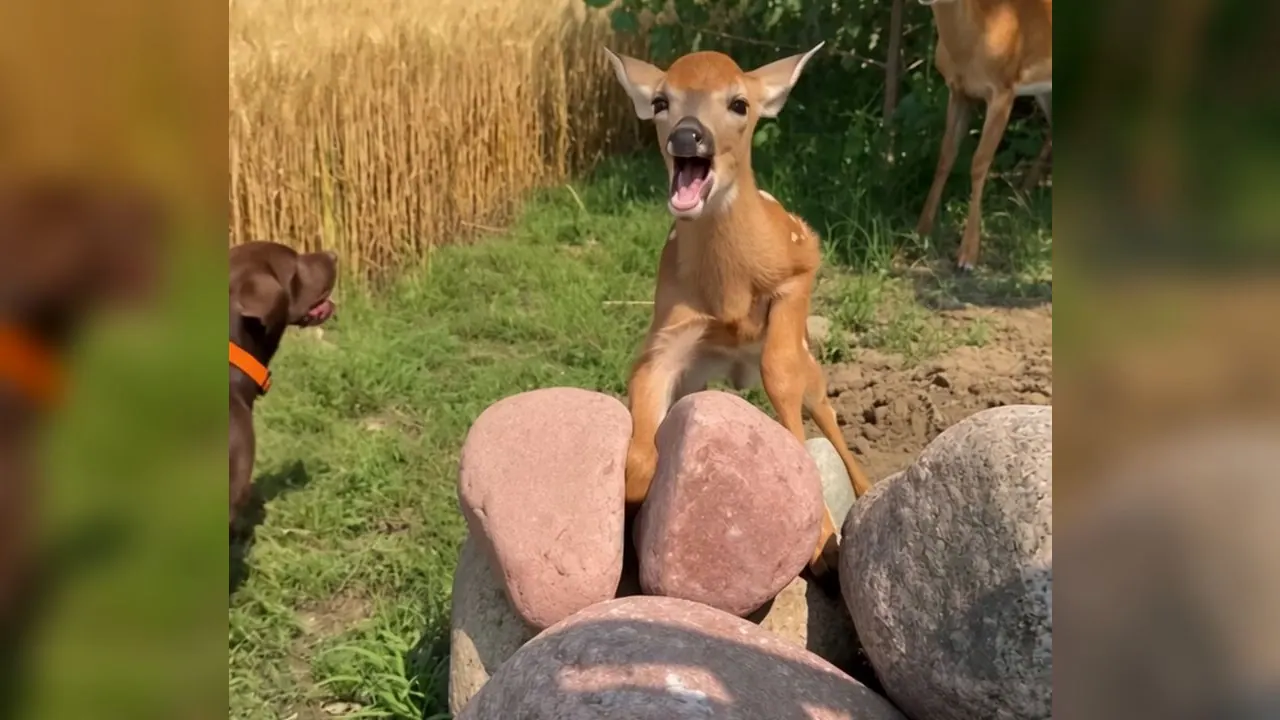
A pile of large, reddish boulders lay resting near the edge of the tall grain.
A dark brown dog wearing a bright orange collar stood watching nearby.
Suddenly, a tiny spotted fawn began to bleat loudly from between two upright boulders.
The fawn threw its head back and opened its mouth wide in distress.
Its front legs rested awkwardly over the top curve of a smooth rock.
The brown dog barked twice in response to the small deer’s cries.
A few yards back, an adult doe stood watching the scene with raised ears.
The doe kept a close eye on the fawn but stayed near the trees.
The brown dog moved closer to sniff gently near the young deer.
The fawn continued to cry out while wedged firmly in the narrow stone crevice.
Its spotted coat caught the direct sunlight as it struggled to adjust its position.
A Man Arrives On Scene
Footsteps sounded along the dirt lane as a man walked into view.
He wore blue work coveralls and a faded baseball cap.
Thick brown leather work gloves covered his hands.
He raised one gloved hand toward the dark brown dog.
“Lie down,” he said.
The obedient dog stopped barking immediately and took several steps back.
The dog lay down quietly near the grass to watch from a safe distance.
The adult deer watched the worker approach without fleeing into the dense tree line.
She shifted her weight cautiously beneath the green leaves.
The man approached the rock pile with steady, measured movements.
The fawn ceased its crying as the worker drew near.
The young deer turned its head to look directly at the man.
Its large dark eyes remained wide as the man stepped over the grass.
The scene remained still under the bright prairie sky.
Examining The Small Deer
The man positioned his feet carefully beside the base of the rock mound.
He looked closely at how the fawn was positioned between the heavy stones.
Both of the animal’s front legs were pinned inside the narrow vertical opening.
The fawn could not touch the ground beneath the boulders with its hooves.
The animal had no visible injuries.
The man reached his heavy gloved hands toward the smooth rocks.
He kept his body low to maintain balance against the slope.
The doe remained completely still just several paces behind him.
She watched every movement the man made near her trapped offspring.
The dark dog rested its chin near the dusty ground without making any noise.
The fawn let out a soft whimper as the gloved fingers touched the stone.
The worker checked to see if the rocks could be shifted by hand.
The boulder on the left weighed a considerable amount.
He leaned forward and prepared to apply force against the rock face.
Lifting The Heavy Stone
The man grasped the outer edges of the two confining stones firmly.
He braced his boots into the packed dirt around the base of the pile.
His muscles strained against the weight of the rough pink stone.
He shifted his weight backward to pry open the tight space.
The fawn tucked its ears flat against its head as the rocks moved.
The man grunted as he levered the left boulder outward by a few inches.
The stone scraped against the lower base rock with a dull grind.
A wider gap opened between the two upright stone slabs.
The man used one hand to support the heavy rock.
He reached his other gloved hand around the fawn’s small chest.
He gently lifted the young animal upward out of the stone trap.
The fawn’s slender legs slipped free from the crevice without catching.
The worker set the shifting boulder safely back onto its foundation.
He kept both hands supporting the fawn until its feet found stable footing.
Taking The First Steps
The fawn stood on top of the large lower boulder for a moment.
It wobbled slightly while testing its slender legs on the rounded stone surface.
The man stepped back to give the animal ample room to move.
He kept his hands near his sides and watched the fawn carefully.
The fawn hopped down from the boulder onto the firm, grassy soil.
It shook its white-tipped tail and turned toward the nearby trees.
Its gait appeared smooth and steady across the level terrain.
The brown dog remained lying down as the fawn scampered past.
The doe stepped forward out from beneath the canopy of the poplar trees.
She stretched her long neck downward toward her advancing fawn.
The young deer ran straight toward the mother without pausing.
They met at the boundary between the sunny path and the woodland shade.
The two deer touched their noses together in an immediate greeting.
The mother thoroughly inspected the fawn’s head, neck, and sides.
Reunion By The Trees
The mother deer gently nudged the fawn with her snout.
The fawn stayed glued to its mother’s flank as she took several steps.
The man watched quietly from beside the rock pile with his dog.
Neither the worker nor the pet attempted to follow the pair.
The doe turned her body toward the dense undergrowth behind the tree line.
She glanced back once toward the human and the resting dog.
The fawn followed closely behind her heels through the tall weeds.
Dry leaves rustled softly under their hooves as they entered the woods.
The green foliage began to conceal the two slender brown figures.
They walked deeper into the thick shelter of the grove.
Within moments, both animals disappeared completely among the upright tree trunks.
The quiet afternoon breeze blew across the adjacent wheat field.
The man pulled off his work gloves and patted his dog.
The landscape returned to a calm and normal rhythm.
The Meaning Behind This Countryside Rescue
Moments involving vulnerable wildlife often capture attention because they display human patience around wild instincts.
The worker understood that remaining quiet and composed was essential for both animals.
He kept his pet under firm control throughout the entire encounter.
The doe demonstrated unusual trust by standing nearby rather than bolting away.
Instead of a fictional cinematic story, this article retells the clip exactly as shown.
When encountering wildlife in difficulty, it is best to assess safety before approaching.
Keeping domestic animals restrained prevents accidental harm during unexpected wildlife encounters.
Local wildlife rehabilitators or conservation officers should be called when animals suffer serious injuries.
The fawn started the scene wedged helplessly between cold stones and ended it walking freely with its mother.