An Approach Across the Shallow Bay Waters
An aluminum skiff drifted forward across the gray, rippling surface of the coastal waterway.
Low clouds hung in a solid layer across the open morning sky.
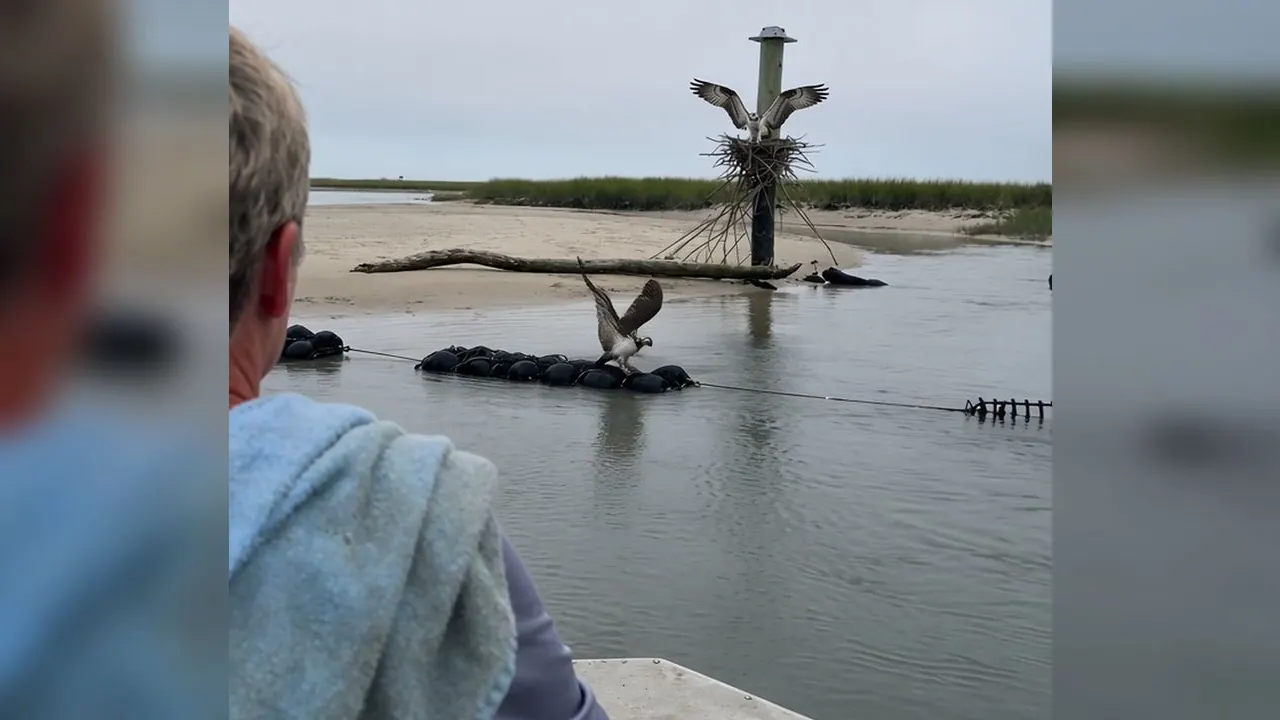
A line of black mesh oyster bags floated along heavy ropes in the shallow tide.
A woman with cropped gray hair stood near the tiller at the stern.
She wore bright orange waterproof overalls over a light gray hooded athletic shirt.
A pale blue terrycloth towel rested loosely across her right shoulder.
In the distance, a tall wooden platform held an empty stick nest above the grass.
A wide sand spit stretched along the left side of the tidal channel.
Suddenly, the woman spotted two large raptors perched near the submerged netting.
One brown and white osprey took flight immediately and beat its broad wings.
The flying bird crossed the channel and landed atop a weathered driftwood log.
The second osprey remained trapped on top of the floating black mesh cage.
Its dark talons were twisted firmly into the heavy commercial netting.
The woman throttled the outboard motor back to a gentle idle.
Careful Movements Beside the Oyster Float
The aluminum hull glided closer to the anchored line of floating black gear.
The trapped osprey spread its wings across the wet wire and struggled briefly.
Its yellow eyes remained fixed directly on the approaching metal craft.
The other bird watched motionless from its perch on the dry beach log.
The woman shifted her weight toward the bow of the small skiff.
She lifted the light blue towel off her shoulder with both hands.
The shallow water lapped softly against the bottom of the aluminum hull.
She bent her knees and reached outward toward the distressed wild raptor.
“Easy baby,” she said softly as she leaned over the gunwale.
The bird opened its sharp hooked beak and let out a quick chirp.
She draped the soft blue fabric smoothly across the bird’s dark back.
The dark fabric covered the bird’s head and immediately quieted its frantic thrashing.
The cords stayed clear of its skin during the delicate initial contact.
Her bare fingers probed the damp mesh to locate the tangled talons.
She grasped the trapped lower foot firmly beneath the protective cloth folds.
Working to Untangle the Claws on Deck
The boat bumped gently against the wet sandbar beside the oyster lease.
The woman kept one hand secure around the bundle on the float.
“I have your foot,” she murmured toward the cloth.
She pulled gently to release the hooked talons from the durable mesh weave.
The osprey fluttered slightly under the towel but did not attempt to bite.
She freed the second foot with a slow, deliberate twist of her fingers.
The animal had no visible injuries around its clean lower leg joints.
She lifted the entire wrapped bird upward into her arms against her chest.
Water dripped from its tail feathers onto the aluminum deck plating.
The second bird on the log leaned forward and watched every movement.
The woman stepped carefully over the metal gunwale into the damp sand.
Her white rubber deck boots sank slightly into the wet coastal soil.
She dropped down onto both knees directly on the flat sandbar.
Examining the Osprey on the Wet Sand
The woman held the wrapped raptor resting comfortably against her orange bib overalls.
She used her right hand to peel back the blue cloth corners.
The osprey exposed its strong gray legs and long curved black claws.
She inspected each toe carefully to make sure no synthetic twine remained attached.
Every talon moved freely without any strands caught around the sharp tips.
The second osprey called out from the driftwood log several yards away.
Its companion answered with a quiet, high-pitched whistle from beneath the fabric.
“Look at you,” the woman remarked in a low, gentle voice.
She slowly pulled the blue towel completely away from the raptor’s body.
The bird stood upright on the wet sand on its own two feet.
Its sharp crown feathers stood erect in the cool, steady coastal wind.
It blinked rapidly as its golden eyes adjusted to the open gray daylight.
The woman kept her hands hovering close by in case it tumbled over.
Preparing for Flight on the Open Shore
The freed raptor shifted its weight and balanced firmly on the sand.
It opened its hooked beak and emitted several loud, piercing territorial cries.
The woman remained still on her knees without making any sudden gestures.
The osprey took two deliberate steps forward across the firm tidal flat.
It turned its head sideways to look directly at the other perched bird.
The partner bird shifted its talons on the bark of the driftwood.
The grounded bird shook its dense wing plumage to shed clinging droplets.
It ducked its head low and spread both dark wings to full width.
The tips of its primary feathers nearly brushed against the gray drift log.
With a powerful downward thrust, the bird launched itself upward off the ground.
Sand grains scattered across the beach beneath the sudden rush of air.
The bird rose steadily into the low ceiling of cool morning clouds.
Reunion Over the Coastal Marshes
The second osprey lifted off the driftwood log at the exact same moment.
Both broad-winged birds climbed together above the green salt marsh grasses.
They circled in tandem over the shallow bay and the wooden nesting platform.
Their distinctive whistling calls echoed across the flat, open expanse of water.
The woman stood up from the wet sand and watched them ascend.
She shook the damp sand out of the blue towel with both hands.
The two raptors caught the wind and glided effortlessly toward the treeline.
Neither bird showed any sign of a limp or an uneven wingbeat.
The woman picked up her gear and turned back toward the idling skiff.
She climbed back aboard the metal boat and pushed off from shore.
The oyster floats bobbed quietly behind her along the surface of the channel.
The waterway returned to its quiet rhythm under the overcast gray horizon.
The Meaning Behind This Coastal Rescue
This encounter demonstrates the fragile boundary between working coastal industries and native wildlife.
Tangled birds often panic and cause severe self-inflicted damage when approached by humans.
Covering the eyes of a raptor remains the most effective way to reduce stress.
A calm human voice and steady, non-threatening posture prevent unnecessary struggle.
The partner bird showed clear attachment by remaining near the site throughout the encounter.
Unlike an artificial drama or fictional cinematic story, this recorded footage shows an authentic real-life interaction.
Untrained observers finding entangled raptors should immediately contact local wildlife rehabilitators before attempting hands-on contact.
Sharp talons can easily pierce human flesh without heavy gloves or thick protective toweling.
The boater arrived at a helpless bird pinned to wet floating commercial gear.
She left behind an empty sandbar as two healthy raptors soared overhead together.