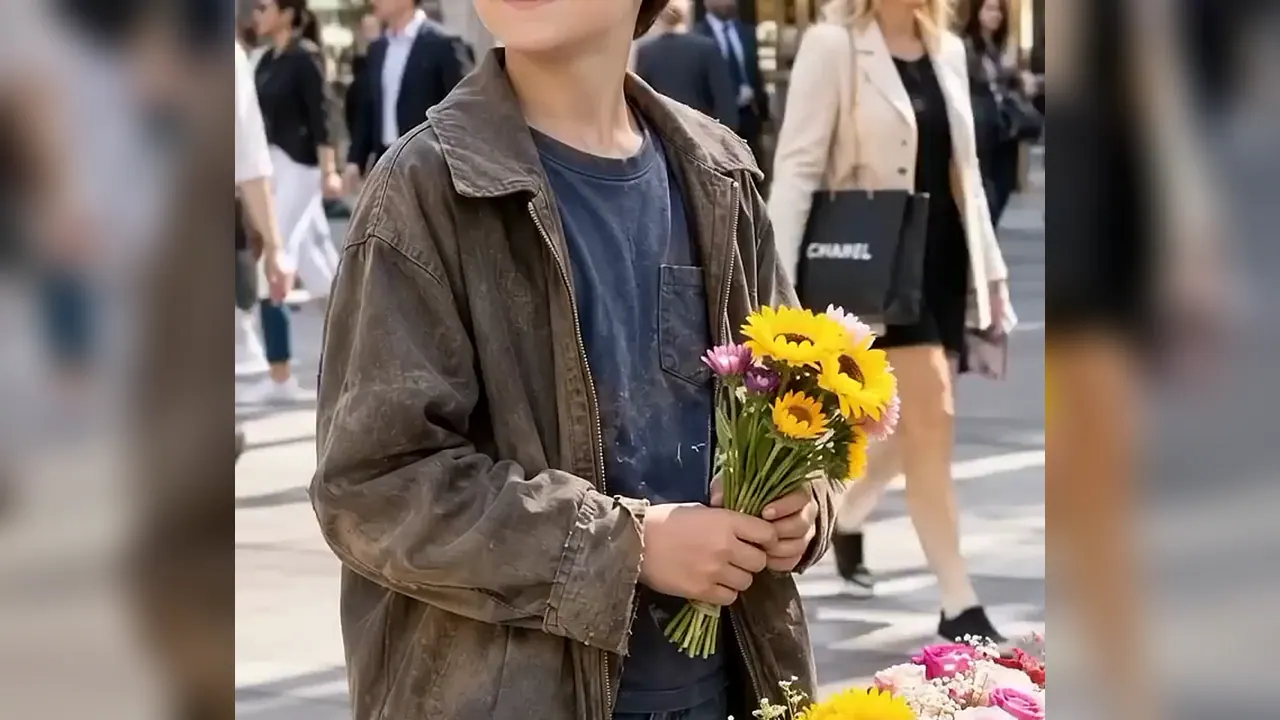
A Young Peddler on the Busy Sidewalk
Pedestrians walked across the wide concrete pavement beneath bright midday sunlight in the city.
Tall glass storefronts with polished brass lettering lined the busy commercial avenue.
A boy in an oversized brown jacket stood beside a pair of stacked wicker baskets.
His denim jeans showed tears near the knees, and his shoes were visibly scuffed.
Fresh yellow sunflowers and pale pink blooms filled the upper basket near his waist.
A cardboard sign tied with string displayed handwritten letters reading fresh flowers.
Suddenly, the boy lifted a bundle of bright sunflowers toward passing shoppers.
“Please buy some flowers,” he said.
Crowds walked past him without pausing to inspect the colorful arrangement.
Office workers holding paper coffee cups continued moving toward the nearby crosswalk.
The boy looked down at two crumpled dollar bills resting inside his open palms.
He folded the currency carefully and slipped it into his deep front pocket.
A ringing sound came from the small mobile phone tucked beside his belt.
The screen illuminated with an incoming call from his mother.
He raised the device to his ear while stepping closer to the storefront.
A Sharp Exchange Outside the Boutique
A woman wearing an ivory tweed jacket and matching skirt approached the display baskets.
A black designer purse hung over her shoulder on a polished gold chain.
The boy stepped forward and held out a small bouquet of yellow sunflowers.
“Excuse me, miss,” he said.
The woman stopped abruptly and looked down at the bouquet in his hand.
Her eyebrows drew together as she glanced between his clothes and the blossoms.
She shook her head while stepping back from the wicker baskets.
“Are you seriously selling those here?” she asked.
The boy lowered his arms and stood motionless on the gray pavement.
The woman pointed toward the luxury clothing displays inside the glass windows.
She spoke sharply while shifting the strap of her bag on her shoulder.
She stated that visitors to the district expected higher standards from vendors.
A single yellow sunflower slipped from the wrapping and fell onto the stone tiles.
She turned her back to the boy and strode away down the avenue.
The boy bent down, picked up the fallen flower, and wiped his face.
An Overheard Phone Call Near the Pillar
The boy stepped back against the cool stone facade of the department store.
He dialed a number on his phone and lifted the handset to his ear.
Around the adjacent stone pillar, the woman in the tweed outfit paused her stride.
She stopped behind the square corner and leaned closer to the stone wall.
The boy asked into the phone whether any administrators had called that morning.
A woman’s voice came through the speaker, mentioning a pending enrollment deadline.
The boy told the caller that he would find a way to manage.
Behind the pillar, the listening woman rested her manicured hand against the stone.
Her mouth remained slightly open as she heard the brief telephone exchange.
The boy lowered his phone and slid it back into his jacket pocket.
He looked down at the basket of unsold flowers on the sidewalk.
The woman stepped out from behind the pillar and approached him again.
Her posture appeared markedly different than during their initial encounter moments earlier.
She stopped two paces away and looked directly into his eyes.
A Difficult Truth Revealed in Conversation
The woman inquired about the program he had mentioned during his phone call.
The boy explained that his six-year-old sister experienced severe hearing impairments.
He stated that medical instructors had accepted her into a specialized speech course.
“We need money,” he said.
He explained that the enrollment fee required payment before the upcoming Monday morning.
The woman stood quietly while absorbing the details of his family situation.
Her eyes drifted toward the simple flower basket resting on the sidewalk.
She asked no further critical questions about his appearance or his street goods.
The boy looked up at her without offering excuses or showing resentment.
Pedestrians continued walking past their position without paying attention to the conversation.
The woman clasped both hands together in front of her ivory jacket.
She nodded once in acknowledgment of what he had told her.
Without purchasing any flowers, she turned and walked toward a waiting car.
The boy remained beside his wicker baskets on the crowded sidewalk.
A Mother Offers Guidance at Home
Later that afternoon, the woman sat on a beige sofa inside a spacious living room.
Her mother sat beside her, dressed in a formal black dress with a silver brooch.
Large arrangements of white hydrangeas stood on polished side tables across the room.
The younger woman held her head in both hands as tears streaked her cheeks.
She recounted how harshly she had spoken to the boy selling blossoms.
She explained that she had judged his character entirely by his ragged clothing.
Her mother reached over and rested a comforting palm against her daughter’s arm.
The older woman recalled past years when reading lessons had caused intense personal distress.
She reminded her daughter that a kind instructor had shown patience rather than disapproval.
She noted that belittling others never resolved internal feelings of inadequacy.
The daughter looked up and wiped her wet cheeks with a paper tissue.
“How do I make things right?” she asked.
The mother instructed her to convert her regret into practical, constructive assistance.
She urged her daughter to act rather than dwell indefinitely on past mistakes.
A Second Meeting Beside the Floral Basket
The next morning, the boy stood beside his wicker display on the sidewalk.
The woman in the tweed outfit walked up and knelt before him on the pavement.
She extended a white paper envelope and a wrapped blue box tied with ribbon.
The boy looked down at the unexpected parcel resting in her outstretched hands.
She apologized directly for the harsh remarks she had made the previous afternoon.
She admitted that judging him based upon his worn clothes had been wrong.
She explained that her family foundation had agreed to fund his sister’s program.
The grant covered tuition, specialized transport, and necessary medical auditory devices.
The boy took the envelope and pressed it firmly against his chest.
Tears welled in the corners of his eyes as he shook his head.
“Thank you,” he said.
He smiled through his tears while grasping the ribbon on the gift box.
The woman smiled back warmly as she rose to her feet on the sidewalk.
Shoppers continued walking past, completely unaware of the agreement made between them.
Words Spoken at the Foundation Podium
Months later, bright banners for a community foundation hung across an auditorium stage.
The woman stood behind a clear acrylic lectern holding a handheld silver microphone.
She wore a polished cream tweed suit similar to the one worn months prior.
The boy stood beside her, dressed in a navy blazer and crisp buttoned shirt.
His young sister stood in front of them, wearing a light blue floral dress.
The girl smiled broadly toward the seated audience gathered in the hall.
The speaker addressed the crowd about the lessons learned from their first street meeting.
She explained that external wealth does not determine a person’s dignity or worth.
The boy looked up at her with clear admiration as she delivered the remarks.
The little girl adjusted a blue ribbon tied neatly in her brown hair.
The audience applauded warmly from their rows of cushioned seats below the stage.
The three individuals remained grouped together in front of the charitable emblem.
The Meaning Behind This Modern Tale
The sequence functions through clear contrasts between urban wealth and family necessity.
Visual markers like frayed denim and luxury storefronts establish immediate social divisions.
The pivotal moment relies on overhearing authentic responsibility rather than staged confrontation.
The narrative demonstrates how private counsel can transform defensive guilt into tangible action.
The transformation from harsh rejection to institutional sponsorship creates a satisfying emotional arc.
This video represents a fictional cinematic story designed to promote empathy and social awareness.
In real urban settings, individuals should verify charitable credentials before donating significant sums.
Communities often maintain legitimate family resource centers to assist children needing specialized medical care.
The narrative begins with an isolated peddler facing mockery and concludes with a public celebration of mutual respect.
Share this with someone who believes that kindness and humility can transform lives.