A Morning Commute Across The City
Gray morning light filtered through the scratched windows of the crowded public transit bus.
Several passengers sat quietly along the blue fabric seats while the vehicle rolled down the avenue.
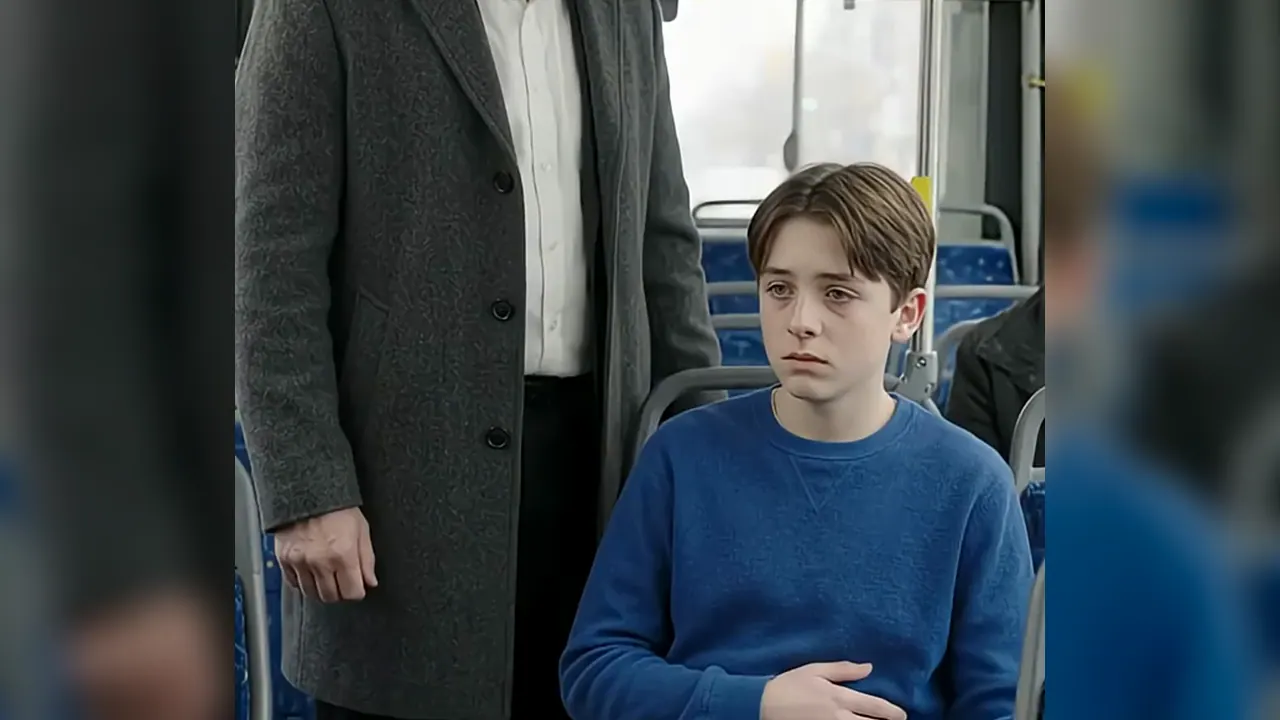
A teenage boy wearing a bright blue sweater sat near the center aisle holding his stomach.
His posture appeared curled forward as if trying to shield his midsection from sudden bumps.
A tall man dressed in a dark gray overcoat stood directly in the narrow walkway.
Suddenly, the tall commuter glared down and confronted the quiet teenager directly.
“Get out of that seat,” he demanded loudly.
The man gestured aggressively toward the surrounding rows of seated adults.
He pointed out that a teenager had plenty of energy to stand during the ride.
The boy looked up with wide, worried eyes and kept his hand against his belly.
“I really need to sit down,” the boy replied softly.
He explained in a quiet voice that he was not feeling well at that moment.
The boy said he did not believe he could stay upright on his feet.
The standing man crossed his arms and showed evident disbelief across his face.
He announced to the bus that he had worked twelve hours without sitting down once.
A Demand For A Bus Seat
The commuter claimed the younger generation lacked proper manners and respect for working adults.
He stated loudly that parents ought to instruct their children on showing common decency.
Nearby passengers turned their heads to watch the unfolding confrontation in the aisle.
An elderly woman with neat white hair sat in the adjacent row wearing a sweater.
She leaned forward slightly and looked up at the standing man with a steady expression.
“Please keep your voice calm,” the woman said quietly.
She suggested that making a loud scene inside the vehicle would resolve nothing.
The angry commuter pointed his index finger sharply toward the rear of the bus.
He insisted that the young passenger could easily move to the back section instead.
The boy pressed his lips together and began to rise from the cushioned seat.
“You can have it, sir,” the teenager said softly.
The boy held tightly to the metal vertical pole to balance his swaying body.
The tall commuter slid past him and lowered himself into the vacated cushion.
He adjusted his overcoat and looked satisfied with the outcome of his confrontation.
The man muttered that the lesson in courtesy would benefit the boy later in life.
A Fainting Spell In The Aisle
The teenager stood directly beside the seat while his fingers gripped the cold aluminum pole.
His breathing appeared shallow as his shoulders slumped toward his chest in obvious distress.
The elderly passenger watched the boy closely and noticed the color draining from his cheeks.
“Your face is completely white,” the woman observed with concern.
She asked the youth if he felt dizzy or needed immediate physical assistance.
The boy leaned his forehead against the pole to steady his blurred vision.
He revealed in a halting voice that he had undergone surgery three days earlier.
A physician had explicitly instructed him to avoid standing for extended periods of time.
The boy explained that his mother could not leave her job to transport him home.
He had attempted to travel alone on the bus following his follow-up medical appointment.
The seated commuter glanced upward with a sudden flicker of doubt in his eyes.
The man asked if the teenager was being completely honest about having an operation.
The boy opened his mouth to reply, but his knees buckled without warning.
His fingers slipped away from the metal support post in an instant.
The boy fell sideways onto the ribbed rubber floor of the moving passenger vehicle.
A Call For Urgent Medical Aid
The fallen teenager lay motionless on the dirty transit floor between the passenger rows.
The tall man sprang upward from the seat with both hands raised in alarm.
He shouted toward the front compartment where the driver operated the transit vehicle.
“Stop the bus right now,” the man yelled loudly.
He called out to the other passengers to telephone emergency services for an ambulance.
The vehicle slowed to a halt along the curb as hazard lights flashed outside.
The commuter dropped onto both knees beside the unresponsive boy lying on the floor.
He placed one trembling hand gently behind the unconscious teenager’s neck to support him.
The man unbuttoned his heavy wool coat and pulled his arms free from the sleeves.
He carefully draped the thick fabric across the boy’s chest to preserve his body warmth.
“Please stay with me, son,” the man whispered repeatedly.
He admitted quietly that he had made a grave error in judging the situation.
The man begged the young passenger to keep his eyes open until paramedics arrived.
The boy fluttered his eyelids slightly and stared up toward the illuminated ceiling panels.
The boy whispered weakly that he had told the truth about needing the seat.
Paramedics Arrive At The Curb
The commuter knelt motionlessly on the floor while keeping both hands on the teenager’s shoulders.
He admitted that anger had blinded him from recognizing another human being in physical distress.
Two uniformed paramedics carrying orange medical kits entered through the wide front doors.
They moved down the narrow central walkway and knelt beside the injured teenage patient.
The tall commuter stepped backward into an empty seat to clear the working space.
As the medics worked, the boy reached out and clutched the man’s white shirt sleeve.
“Tell my mother I tried,” the teenager whispered with difficulty.
The boy worried that his mother would believe he had acted recklessly after surgery.
“You did nothing wrong,” the man assured him with a breaking voice.
The man declared firmly that he bore the sole responsibility for what had occurred.
The emergency crew checked the patient’s vital signs and secured him onto a portable gurney.
They guided the rolling stretcher down the aisle and out into the waiting emergency vehicle.
The man gathered his coat and stepped outside onto the pavement behind the paramedics.
He chose to accompany the emergency team to ensure the boy reached care safely.
An Apology In The Hallway
Bright overhead lights reflected off the polished tile floors of the hospital waiting area.
The teenager rested safely behind the closed wooden door of an adjacent examination room.
The boy’s mother walked briskly down the corridor with tears streaming down both cheeks.
The commuter stood near the door frame holding his bundled coat over one arm.
He stepped forward slowly into the woman’s path and bowed his head respectfully.
“I am responsible for your son standing,” the man confessed directly.
He recounted how he had publicly berated the child over an empty bus seat.
He expressed deep regret for humiliating the young boy before fellow city transit passengers.
The mother stared at him and explained that her son had nearly collapsed yesterday too.
She said the physician had strictly forbidden any physical exertion during his early recovery.
“No apology can undo this,” the man conceded in a subdued tone.
He promised never to treat another struggling young person with such hasty disrespect again.
The mother turned away from him without speaking another word in the quiet hallway.
She pushed open the examination room door to sit beside her resting child’s bed.
The man remained standing alone in the bright corridor with his head bowed down.
The Meaning Behind This Public Encounter
This dramatic encounter highlights the invisible medical battles that ordinary commuters face every day.
Visible youth and physical size often conceal hidden surgical wounds or debilitating chronic illnesses.
The scene illustrates how easily exhaustion and workplace stress can cloud a person’s judgment.
It emphasizes the immediate danger of assuming ill intent when someone requests basic consideration.
The sudden turn of events forced a public critic to confront his personal prejudices.
His swift willingness to provide first aid demonstrated that remorse can drive positive action.
This video presents a fictional cinematic story designed to promote empathy in public transit spaces.
In real everyday life, bystanders must never forcibly remove someone from a transit seat.
If a passenger collapses, immediately alert the transit operator and contact certified emergency services.
Trained medical personnel should always evaluate individuals suffering from sudden physical fainting spells.
While the commuter began the journey asserting self-righteous dominance, he ended it seeking humble forgiveness.
Know someone who reminds you to never judge a person by appearances? Send them this.