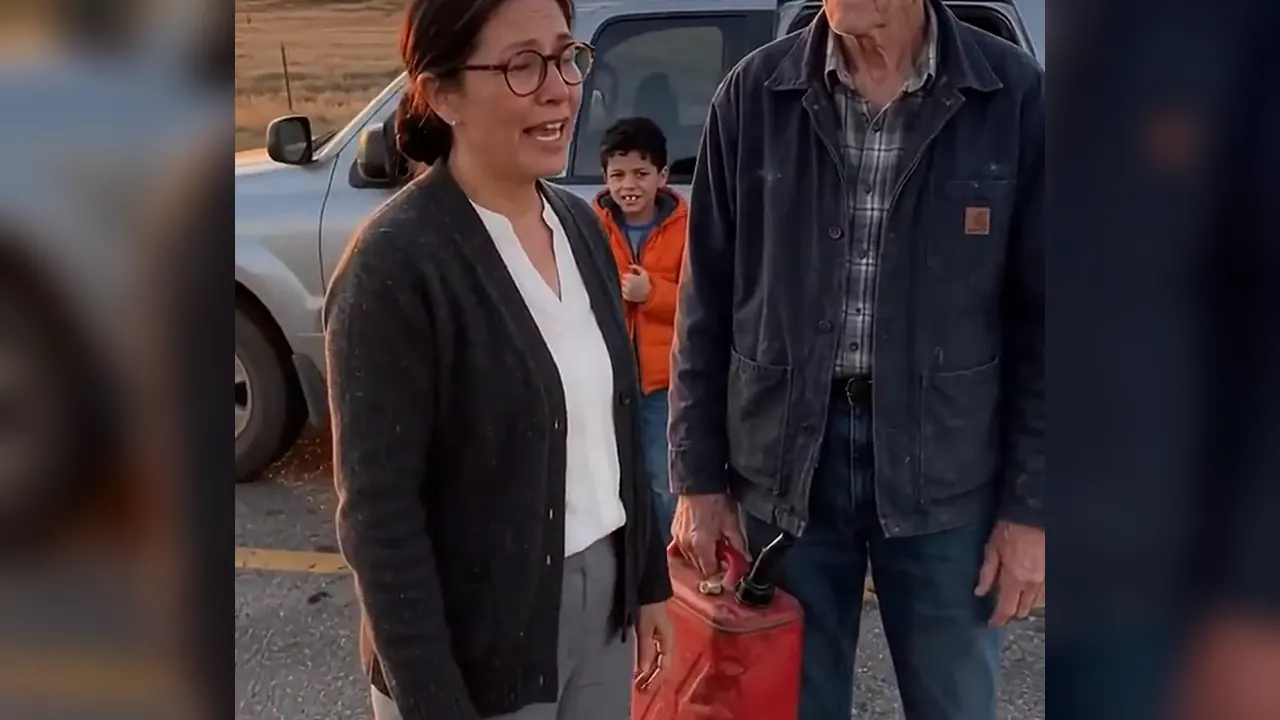
A Low Sunset Along The Country Highway
Golden light fell across the dry grass bordering the narrow two-lane country highway.
A gray-haired rancher stood beside a gravel shoulder in a dark work jacket.
His weathered hands gripped the black handle of a battered red metal fuel can.
A beige pickup truck idled close beside him on the edge of the road.
The driver leaned one arm across the open window frame toward the older man.
Farther back along the asphalt, a silver utility vehicle rested with its hazard lights off.
A woman wearing a dark blazer stood quietly beside a small boy in an orange coat.
The driver of the idling truck pointed toward the red fuel container with a smirk.
He warned that giving away the remaining fuel would leave the older man walking.
The rancher turned his head toward the distant fields under the setting prairie sun.
The wind blew softly across the open plain while the two vehicles remained parked.
Suddenly, the woman approached the older man with both hands clasped over her chest.
She explained that her purse was missing and the nearest fuel station was forty miles away.
“Forget repaying,” the rancher said.
He gestured toward the shivering child standing near the silver vehicle’s open rear door.
He urged her to warm the boy and start the engine before darkness fell.
The driver inside the pickup scoffed aloud before shaking his head in open disbelief.
He reminded the rancher that without legal paperwork, his family pasture was already forfeit.
An Official Meeting Beside The Old Windmill
Morning sunlight illuminated the white wooden farmhouse and its tall steel windmill.
A county official in a brown sports coat held a wooden clipboard before the gate.
The gray-haired rancher stood nearby on the loose gravel driveway in his denim jacket.
Beside them, the pickup driver rested his arms over a metal mailbox near the road.
The official flipped through the stapled pages attached firmly to his wooden board.
He reported that the local zoning committee scheduled their official vote for nine o’clock tomorrow.
He explained that without an original property deed, the land board could offer no help.
The rancher looked toward the tall yellow cottonwood trees standing near the fence boundary.
He stated that his late wife’s father had plowed those exact fields decades ago.
The driver stepped forward onto the driveway while holding a folded paper check aloft.
He offered forty thousand dollars to settle the land boundary dispute on the spot.
“My trees aren’t for sale,” the rancher said.
He kept both hands inside his pockets while declining the paper offer without moving.
The county representative looked down at his notes as the chilly morning wind blew.
The pickup driver folded his paper check and placed it back into his vest pocket.
He announced that the local county government would award him the acreage regardless.
A Tense Hearing Inside The Wooden Chamber
Warm indoor lighting filled the high-ceilinged hearing chamber lined with dark wooden benches.
The presiding official sat behind a raised mahogany desk beneath a framed district map.
The gray-haired rancher stood straight at a wooden lectern facing the elevated bench.
Across the center aisle, the neighbor sat back with his arms crossed over his chest.
The presiding official adjusted his metal eyeglasses and looked toward the lectern.
He asked whether any official archival paperwork existed to support the family boundary claim.
The rancher replied that he possessed only his spoken word and decades of maintenance work.
He described trimming the fence line and preserving the trees planted along the ditch.
The neighbor rose from his chair and demanded an immediate vote from the chair.
He insisted that unrecorded claims could not be recognized under the current county rules.
The presiding official raised his wooden gavel above the polished wooden sounding block.
He declared that he must call the motion unless new evidence entered the room.
A Sudden Arrival At The Double Doors
The heavy wooden door at the rear of the chamber clicked and swung open.
The woman from the roadside entered the room alongside the young boy in orange.
She carried a thick cream-colored folder fastened securely with a wide red ribbon.
The seated neighbor turned around sharply in his wooden chair to watch them enter.
She announced herself as an archivist employed directly by the state records department.
She explained that she had searched the state vault for the missing nineteenth-century filing.
The presiding official lowered his wooden gavel and gestured for her to step forward.
She walked down the center aisle while the boy held onto her wool sleeve.
The rancher watched quietly from his wooden lectern as she reached the elevated desk.
She placed the unbound records flat across the smooth surface of the wooden bench.
The presiding official leaned down close to examine the faded ink and embossed stamp.
She pointed directly to an original registration dating back to nineteen fifty-two.
“Sealed and genuine,” the official said.
He announced to the courtroom that the disputed pasture belonged legally to the rancher.
A Decisive Finding On The Boundary Line
The neighbor surged forward against the railing while shaking his hand in anger.
He shouted that the historic paper could easily be an unverified private reproduction.
The archivist picked up a supplemental sheet from the open cream-colored document folder.
She explained that state microfilms verified the precise boundary lines recorded decades earlier.
She noted that recent surveys showed his fence encroached eleven feet past the border.
The presiding official took off his reading glasses and picked up the heavy gavel.
He struck the sounding block firmly with a loud crack that echoed across the room.
He formally dismissed the adverse possession petition filed against the rancher’s family acreage.
He ordered the neighbor to remove his encroaching fence entirely by the month’s end.
The neighbor gathered his papers from the wooden table in silence and stepped back.
The rancher placed his hand over his chest and nodded toward the presiding judge.
Observers sitting in the back gallery gathered their coats as the hearing adjourned.
A Surprising Gift In The Empty Courtroom
The archivist and her young son walked across the room toward the rancher’s lectern.
The boy smiled broadly while holding the familiar red metal fuel can in both arms.
The child lifted the heavy metal can carefully toward the older man’s open hands.
The archivist explained that her son insisted on purchasing fresh gasoline before returning home.
The container was filled completely to the top spout with clean automotive fuel.
The rancher placed one hand on the container’s nozzle and smiled at the boy.
He said that a full fuel can was the finest receipt anyone could offer.
The woman thanked him warmly for his assistance along the highway the previous week.
The young boy watched proudly as the rancher accepted the red metal container.
The rancher gripped the top handle and carried the fuel can toward the exit.
All three walked together through the open wooden doors into the bright sunlight.
A Familiar Encounter Along The Shoulder
The prairie sun hovered low above the horizon along the same two-lane country highway.
The gray-haired rancher stood on the gravel shoulder with his filled red fuel can.
The neighbor’s beige pickup truck sat stopped awkwardly near the edge of the grass.
The neighbor leaned through the rolled-down driver window with an embarrassed expression.
He admitted that his fuel tank had run dry forty miles from the nearest town.
He asked whether the rancher could spare a single gallon from the red container.
The rancher looked down at the nozzle before looking back at the stranded driver.
“Move that fence,” the rancher said.
He agreed to provide the needed gasoline while reminding him of the boundary order.
The neighbor nodded slowly from the driver seat as the rancher unscrewed the nozzle cap.
The Meaning Behind This Country Resolution
This sequence illustrates how modest generosity during an everyday emergency can yield unexpected consequences.
The initial roadside interaction established clear stakes without relying on elaborate staging or dialogue.
The sudden arrival in the county courtroom connected the opening scene to the main conflict.
Visual contrast between the two drivers highlighted differing attitudes toward community and property.
The cyclical return of the red fuel container brought closure to the unfolding situation.
Viewers should understand that this production is a fictional cinematic story created for entertainment.
When traveling remote country highways, drivers should always monitor fuel gauges and maintain reserves.
Individuals disputing property boundaries should consult official county land registries and licensed land surveyors.
The rancher began by giving away his final reserve and finished with his land secured.
Know someone who still believes that doing the right thing comes back around? Share this with them.