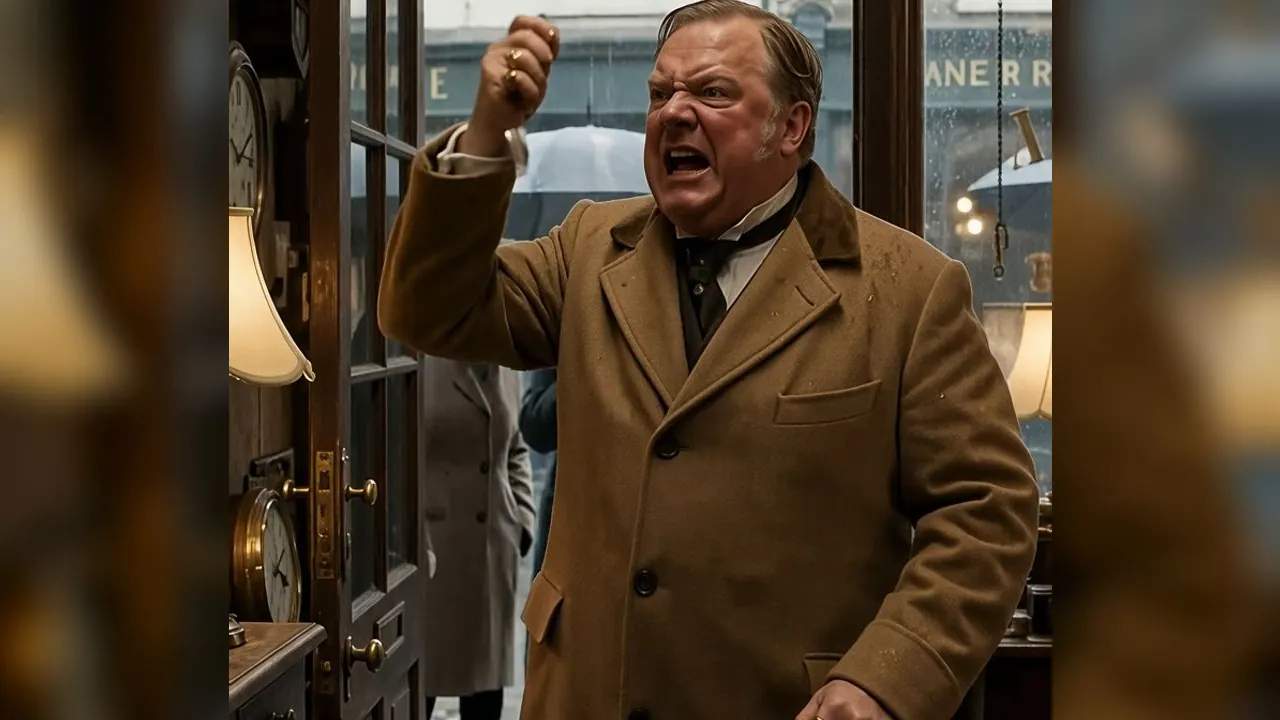
An Angry Intrusion In The Clock Shop
Dozens of pendulum clocks hung neatly along the wood-paneled walls of the quiet shop.
Soft ticking filled the room beneath the warm glow of antique shaded lamps.
A young apprentice wearing a green canvas apron stood beside the central wooden workbench.
Rain fell steadily against the glass panes of the open front street entrance.
Suddenly, a heavy-set man in a tan overcoat pushed open the shop door.
He shook a dripping black umbrella and glared into the warm interior.
In his raised hand, he clutched a gleaming gold pocket watch on a chain.
The visitor shouted loudly toward the street so passing pedestrians turned their heads.
“Your apprentice is a thief!” he shouted toward the ceiling.
Several pedestrians paused on the wet sidewalk outside the shop window to watch.
The man in the coat thrust the pocket watch into the dim light.
“A fake!” he bellowed while shaking the timepiece in the air.
The young craftsman behind the counter looked up with an expression of stunned bewilderment.
A Defense Met With Rising Accusations
The apprentice extended his open hands over the rows of delicate brass gears.
“That is the same watch you brought in,” the young man said.
He explained that he had serviced the delicate mechanism with his own hands.
The visitor disregarded the explanation and continued to shout at full volume.
He threatened to summon every newspaper in town to ruin the shop.
The accuser declared that the modest workshop would be closed by Monday morning.
The young assistant reached across the desk to retrieve a small brown ledger.
“Let me show you my service book,” the worker pleaded softly.
He held the bound journal out toward the outraged customer.
The visitor waved a dismissive hand and rejected the written documentation immediately.
“Books can be written after the fact!” the man barked back.
The young artisan set the small record book back onto the desk.
The street outside remained gray as more spectators gathered near the open entrance.
The Veteran Watchmaker Steps Into View
From the darker rear corner of the workshop, an elderly master watchmaker sat quietly.
The older craftsman wore wire-rimmed spectacles and a dark leather apron.
He held a slender metallic tool while inspecting delicate clock components.
The angry visitor turned his focus toward the seated shop owner.
The customer demanded that the older owner immediately pay him thirty thousand dollars.
The older man gently lowered his precision screwdriver onto the wooden tabletop.
He looked up through his round lenses and folded his hands together.
“Pay you?” the master clockmaker asked in a dry voice.
He paused while glancing between his apprentice and the accusatory visitor.
The apprentice swallowed hard and kept his eyes fixed upon his mentor.
The shop owner slowly pushed his wooden chair back and stood up.
He stated that he would pay only if it was the right watch.
The apprentice watched him with wide eyes and an anxious expression.
The Secret Mark On The Workbench
The elderly proprietor moved toward a wooden cabinet against the far wall.
He slid open a shallow drawer filled with antique timepieces resting in velvet.
He lifted a wooden tray containing several pocket watches onto the glass counter.
The elderly man picked up one silver-cased watch and spoke softly.
He explained that fifty years ago he had established one strict shop rule.
He picked up a tiny engraving stylus from a dish near the lamp.
The camera focused closely on his fingers guiding the needle against metal.
He described how he inscribed a microscopic symbol before any timepiece was opened.
He stated that the mark was too small to see without a lens.
He noted that only he knew the exact design of the engraving.
He set the stylus down beside a velvet tray on the counter.
The old artisan then picked up a handheld magnifying loupe.
He held the glass out toward the customer waiting across the room.
A Decisive Test Before The Street
The senior craftsman stepped close to the customer and held his gaze.
He challenged the customer to identify the secret symbol on the casing.
The customer took the pocket watch into his palm and leaned over.
He squinted his eyes under the ambient light of the workshop lamp.
He pretended to examine the tiny polished crevices along the metal casing.
After a long moment of hesitation, the man blurted out an answer.
“A star,” the visitor declared while pointing toward the ceiling.
He asserted loudly that the hidden mark was a little star.
The elderly shopkeeper paused and offered a very faint smile.
He reached down and gently opened the hinged back of a watch case.
“It is a small wave,” the older man corrected in a calm tone.
The apprentice breathed a quiet sigh of relief beside the ticking clocks.
The customer blinked rapidly as his face flushed with visible embarrassment.
The Truth Exposed To The Onlookers
The master craftsman pointed directly toward the watch in the man’s grip.
He stated clearly that the visitor had never seen any genuine mark.
He declared that the watch being held had never entered his shop.
The customer opened his mouth slightly but could produce no answer.
The veteran horologist gestured toward the velvet tray resting on his counter.
He announced that the genuine timepiece brought in last week was safe.
He picked up the genuine gold timepiece that had been serviced.
He confirmed that the original watch was waiting for its owner.
He pointed out that the watch in the customer’s hand was a cheap copy.
The caught man glanced back at the onlookers standing under their umbrellas.
Without uttering another word, the humiliated customer turned toward the door.
He gripped his wet umbrella tightly and pushed past the small crowd.
He hurried down the rain-soaked sidewalk and disappeared around the corner.
Passing The Keys To The Shop
The young apprentice leaned forward against the edge of the wooden worktable.
He admitted that for a moment he feared the master doubted him.
The elderly owner sat back down in his wooden chair.
“I never doubted you,” the wise veteran replied with a nod.
He explained that he only needed the dishonest accuser to make a false claim.
By letting the scammer name the wrong symbol, the truth was proved.
The old man reached into his apron pocket and retrieved three brass keys.
The heavy keys clinked softly as he set them onto the tabletop.
He remarked that he was growing too old to wind every clock.
He said the shop needed a reputable name that earned public trust.
The veteran craftsman offered the ownership of the business to his apprentice.
The young craftsman looked down at the brass keys with grateful eyes.
He walked over to the glass entry door and turned the sign.
The Meaning Behind This Workshop Drama
The dramatic exchange relies on patience and observation rather than anger.
Quiet preparation protected the vulnerable apprentice from a calculated financial scam.
The elderly craftsman understood that shouting back at an accuser rarely helps.
By asking a single targeted question, he allowed the scammer to trap himself.
The presence of public witnesses made the final vindication undeniable and decisive.
This scene is a fictional cinematic story designed to illustrate professional integrity and mentorship.
In real everyday business disputes, maintaining clear written records provides essential protection.
When facing aggressive fraud or false claims, remaining composed prevents unnecessary escalation.
High-value transactions should always be documented with specific serial numbers and signatures.
An apprentice begins the morning facing disgrace, yet finishes the day holding the shop keys.
Send this to someone who values the quiet power of truth and master craftsmanship.