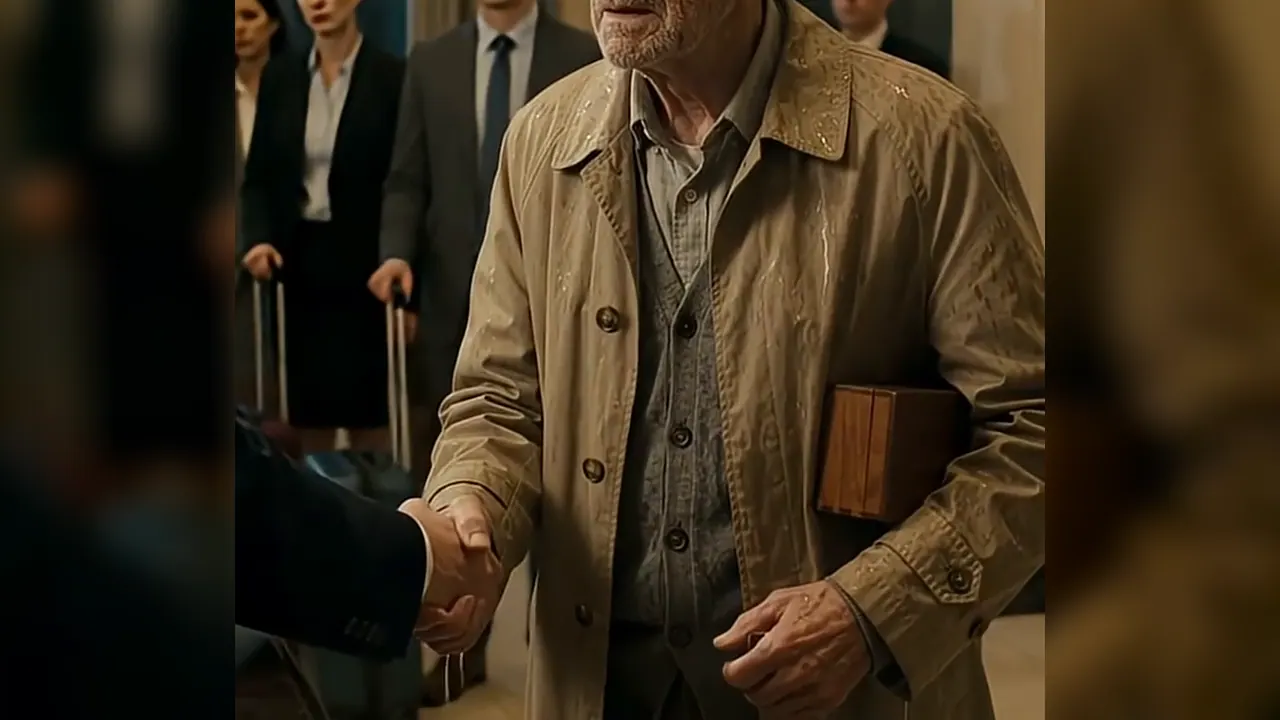
An Unexpected Guest Arrives In The Lobby
Rain tapped steadily against the tall glass panes of the grand hotel lobby.
A line of well-dressed travelers waited patiently beside their rolling luggage.
Warm light shone down from a large crystal chandelier hanging above the marble floor.
Behind the polished wooden counter stood a young desk clerk in a dark jacket.
Suddenly, an elderly man in a wet trench coat stepped up to the counter.
Rainwater dripped from the hem of his coat onto the dark stone floor.
He held a small wooden box carefully against his chest with both hands.
The clerk looked across the counter with a firm and guarded posture.
He stated that the convention had completely filled every available room tonight.
The elderly visitor looked back calmly and spoke in a soft voice.
“I do not need much,” he said.
He placed an old brass key with a round tag on the counter.
A small pool of water gathered around the metal tag labeled four twelve.
The clerk stared down at the key with an impatient shake of his head.
The visitor reached into his worn coat and pulled out a leather wallet.
He laid a stack of paper currency neatly beside the brass key.
He explained that he wished to pay cash for any open room.
The clerk pushed the cash back across the polished wooden surface immediately.
Strict Rules At The Reception Counter
The clerk stated firmly that hotel policy prohibited cash transactions for walk-in arrivals.
He explained that taking cash payments without a credit card created an operational problem.
Behind the older man, travelers checked their wristwatches and shifted in the line.
The elderly visitor placed his weathered hand gently over the brass key.
The clerk picked up the key and held it up toward the lobby lights.
He announced that this mechanical key belonged to an outdated locking system.
He claimed the entire brass lock system had been retired almost twenty years earlier.
He called out toward the entrance for the lobby security guard to assist.
The visitor clasped the wooden box tighter and looked down at the counter.
“Please, it is not a trick,” he whispered.
He asked the clerk to check the hotel register for room four twelve.
A woman in a beige coat stepped forward from the waiting line.
She held out a modern bank card toward the young clerk.
“Put it on my card,” she said.
She insisted that the visitor should have a room regardless of the cost.
The clerk shook his head and refused her generous offer just as firmly.
He explained that third-party card payments for walk-ins violated standard company regulations.
Searching The Records Behind The Desk
The visitor spoke again and asked the clerk to check for an existing reservation.
He offered two family names that might be recorded in the hotel computer.
The clerk tapped briefly on his keyboard while staring at the glowing monitor.
He reported that neither name appeared on the arrival list for the entire week.
The visitor looked toward the floor as the answer sank in.
The clerk suggested that the man should walk to a church two blocks away.
He remarked plainly that the luxury hotel was not a shelter for travelers.
Water continued to drip slowly from the visitor’s wet gray hair and coat.
The woman in the beige coat covered her mouth in visible distress.
A tall security guard in a dark suit walked up beside the older man.
The guard spoke politely and offered to walk the man out into the street.
The visitor nodded gently and picked up his currency from the counter.
“I will wait outside,” he said.
He turned around and began walking slowly toward the revolving glass doors.
Wet footprints marked the polished marble tiles behind his slow and measured steps.
The clerk called after him that standing in the entryway blocked the fire exit.
A Discovery In The Manager’s Office
A woman in dark business attire and glasses walked briskly toward the front desk.
She introduced herself as the general manager and asked what was happening.
The visitor stopped near the front doors and turned back to face her.
He shared his name and mentioned that his wife had arranged the stay long ago.
The manager listened carefully and looked down at the counter where the key lay.
She picked up the brass key and examined the engraved numbers closely.
She instructed the front desk clerk to keep serving the waiting line.
Then she carried the brass key into the private back office behind the desk.
The clerk complained aloud that an obsolete key held no real value today.
Outside the tall glass windows, heavy rain continued to fall into the dark street.
The manager opened an old metal filing cabinet tucked away in the back corner.
Inside a paper folder, she discovered an original yellowed reservation slip.
A bold red stamp marked the paper clearly with the word paid.
The document showed a permanent reservation created twenty years prior for room four twelve.
The manager held the paper slip carefully and walked back into the lobby.
An Overdue Apology In The Lobby
The manager presented the yellowed document to the clerk behind the desk.
The clerk read the handwriting on the ancient paper slip with widened eyes.
The document confirmed that the room had been reserved and paid for in advance.
The clerk stared down at the counter in sudden silence.
He walked out from behind the reception counter and approached the older man.
Tears formed in his eyes as he looked at the visitor’s soaked coat.
He apologized sincerely for his earlier dismissal and for his harsh words.
The older man shook his head softly with a calm and gentle expression.
He noted quietly that no one had asked why he carried the box.
The clerk offered to carry the visitor’s wet luggage up the main elevator.
The visitor held the small wooden box firmly against his chest.
The other guests in the lobby watched quietly as the two men walked past.
The woman in the beige coat watched them leave with a peaceful expression.
Entering Room Four Twelve
The clerk and the visitor walked side by side down the carpeted hallway.
Framed pictures and soft wall lamps lined the quiet corridor on the fourth floor.
The clerk explained that the manager had deliberately kept the original lock intact.
They stopped directly outside a dark wooden door marked with shiny brass numerals.
The numbers four twelve gleamed under the warm lighting of the quiet hallway.
The older man lifted the brass key toward the keyhole below the modern handle.
His fingers trembled slightly as the metal key slid smoothly into the cylinder.
The lock turned with a solid and familiar click inside the heavy door.
The clerk opened the door wide and welcomed the guest inside the room.
A warm lamp illuminated a neatly made bed with pristine white linens.
A clear glass vase of fresh white roses sat upon a round wooden table.
Rain beat softly against the dark window looking out over the glowing city.
The older man walked toward the table and placed the wooden box down.
He smiled softly as he rested his weathered hands on the polished wood.
Then he looked up and asked the clerk to stay for a moment.
He unlatched the brass clasp on the front of the wooden keepsake box.
The Meaning Behind This Hotel Encounter
The scene illustrates how rigid enforcement of corporate procedures can overlook genuine human commitments.
The young clerk focused solely on current software systems and short-term occupancy goals.
The physical brass key served as tangible proof of a promise made decades earlier.
The manager demonstrated that diligence and patience can restore dignity to a difficult situation.
The presence of other guests highlighted how communal support often emerges in public spaces.
The wooden box added a poignant personal weight to what seemed like a routine transaction.
This clip is a fictional cinematic story designed to examine institutional empathy through dramatic storytelling.
In real travel situations, keeping digital and physical copies of booking confirmations prevents administrative disputes.
When unexpected accommodation hurdles occur, remaining calm and speaking directly with senior management yields better results.
Frontline staff should always consult supervisors before turning away vulnerable travelers during severe weather events.
The elderly traveler began his evening rejected in the cold and ended it honored in his room.
Send this to someone who always looks past appearances to see a person’s true worth.