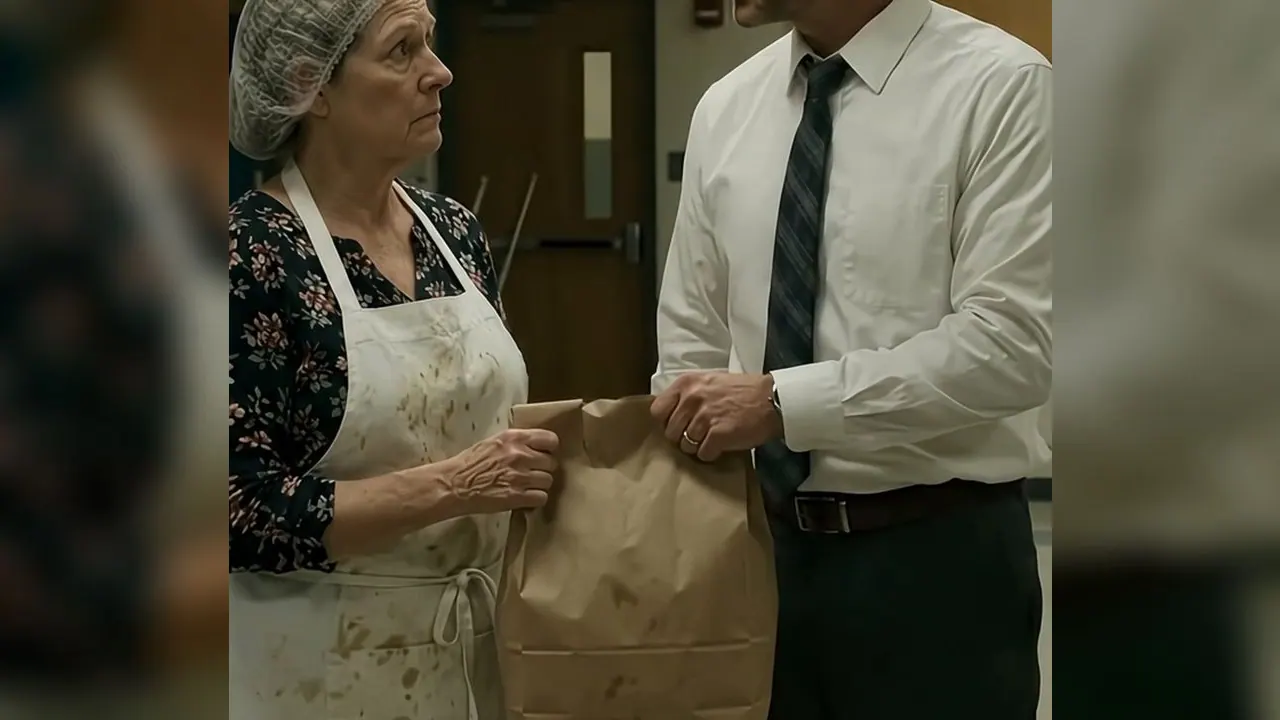
A Confrontation in the Empty Cafeteria
Fluorescent ceiling lights illuminated the wide, quiet expanse of the school cafeteria.
Stacks of metal chairs rested upside down upon the long dining tables.
An older woman in an apron walked steadily toward the cafeteria exit.
She carried a large brown paper sack securely in both hands.
A thin hairnet covered her gray hair as she walked forward.
Suddenly, a tall administrator in a necktie stepped into her path.
He reached forward with both hands and grabbed the paper sack.
The woman stopped walking and looked directly into his stern face.
“What is in the bag?” he asked.
She kept both hands resting lightly on the grocery sack.
“Leftovers that get thrown out,” she said.
The administrator frowned and tightened his grip on the brown paper.
He declared that cafeteria food was strictly property of the school.
He stated that kitchen provisions had disappeared mysteriously for several months.
His tone suggested that she had taken school food without authorization.
The cafeteria worker remained composed under his direct, accusatory stare.
A Quiet Walk Down the School Corridor
The administrator took the paper sack into his own right hand.
He turned away and gestured toward the double hallway doors.
Both staff members walked side by side down the long corridor.
Their footsteps echoed against the smooth floor and metal lockers.
Overhead fluorescent lamps illuminated the quiet path through the school building.
Two passing teachers paused near an open classroom to watch them.
Neither individual spoke while traveling along the central educational hallway.
The cafeteria worker walked forward with her hands folded neatly together.
The administrator held the grocery sack firmly while looking straight ahead.
They approached an office doorway labeled with a formal metal plate.
He opened the heavy wooden door and motioned for her entry.
She stepped into the private administrative office without any outward hesitation.
The administrator entered behind her and pulled the door completely shut.
The latch clicked securely, isolating them from the public corridor outside.
An Accusation Made Across the Office Desk
The office contained tall metal filing cabinets and a wooden desk.
The administrator set the brown grocery sack onto the desk surface.
The cafeteria worker sat down calmly in a nearby visitor chair.
She rested her hands flat against her stained kitchen apron.
The administrator stood by his desk and retrieved a black smartphone.
His expression remained stern as he looked down at the worker.
He announced that an unpaid suspension would begin during an inquiry.
The woman listened to his severe statement without displaying panic.
“Open the bag first, please,” she requested.
The administrator hesitated with his finger over the lit phone screen.
He lowered the mobile device onto a stack of printed papers.
His attention shifted toward the grocery bag standing on his desk.
He extended his hands toward the folded top of the sack.
The woman watched his deliberate movements from her chair in silence.
The room remained quiet as he prepared to inspect the contents.
Unwrapping the Contents of the Brown Sack
The administrator pulled apart the upper folds of the brown sack.
Several rectangular packages wrapped in silver foil lay stacked inside.
Strips of beige tape sealed the edges of each foil bundle.
Handwritten ink noted a student name and day on each package.
The administrator reached inside and lifted the top parcel out carefully.
He turned the shiny bundle beneath the lamp to read it.
“Marcus, Friday,” he read from the label.
The woman looked up and explained the purpose of the food.
She stated that certain children came from financially struggling homes.
She prepared extra meals on her own personal time after hours.
She purchased supplemental groceries with her own money when needed.
Each package contained a complete meal prepared for an impoverished student.
She packed the food so children would not starve over weekends.
The administrator stood entirely still while listening to her quiet explanation.
He placed the labeled foil parcel gently onto his desk surface.
Additional wrapped meals remained resting inside the open grocery bag.
His rigid posture began to relax as her intentions became clear.
A Worn Notebook Placed on the Desk
The woman reached into the pocket of her stained white apron.
She pulled out a small, blue notebook with heavily worn corners.
She placed the small bound ledger directly onto the wooden desk.
The administrator opened the faded blue cover with his fingers.
Lined pages displayed handwritten dates, student names, and monetary values.
Small entries like two dollars and ten cents filled each column.
The woman stated that these entries represented unpaid student lunch balances.
Indebted students were often issued debt slips at the lunch register.
She paid every individual balance personally to shield them from shame.
She wanted every child to eat without experiencing public embarrassment.
The administrator turned page after page filled with dense financial entries.
“Four years,” he noted in disbelief.
“About eleven thousand dollars,” she stated calmly.
She explained that she stopped counting the total after year one.
The administrator rested his open hands upon the handwritten ledger pages.
He shook his head gently while studying the extensive financial record.
His initial skepticism vanished entirely as he reviewed the evidence before him.
An Unexpected Knock at the Office Door
A firm knock sounded against the wood of the office door.
The door opened to reveal a woman wearing light blue scrubs.
A young boy stood beside her, looking into the quiet room.
The mother apologized for the interruption and introduced her young son.
She stated that her boy saw the cafeteria worker facing trouble.
The mother explained that she worked long overnight shifts at work.
Providing adequate daily meals often proved difficult on her limited budget.
“She is why he eats,” the mother said.
The boy stepped toward the seated worker with an eager expression.
The older woman smiled warmly and opened her arms toward him.
The young boy hugged her neck tightly in an affectionate embrace.
She patted the boy gently on his back before releasing him.
The administrator watched the tender encounter without making any critical remarks.
The mother placed a guiding hand onto her son’s small shoulder.
She offered a grateful nod before leading the boy outside again.
The office door closed quietly, leaving both staff members alone together.
The administrator turned back toward the open notebook on his desk.
He looked down at the names, deeply affected by the revelation.
The Meaning Behind This Quiet School Sacrifice
This dramatization illustrates the quiet sacrifices often made by school workers.
The narrative demonstrates how rigid policy can overlook genuine community care.
The labeled meals and worn ledger symbolize profound personal generosity.
The arrival of the mother and child underscores that real impact.
Viewers connect with the story because childhood hunger remains widespread.
This production portrays a fictional cinematic story exploring empathy and rules.
Families experiencing food insecurity should consult school coordinators or local pantries.
Citizens wishing to help can donate to certified school lunch funds.
The administrator begins the encounter as an accuser, but ends humbled.
Share this with someone who quietly looks out for others when nobody else is watching.