An Early Morning at the Loading Dock
Dawn light spread across the orchard behind the weathered wooden barn.
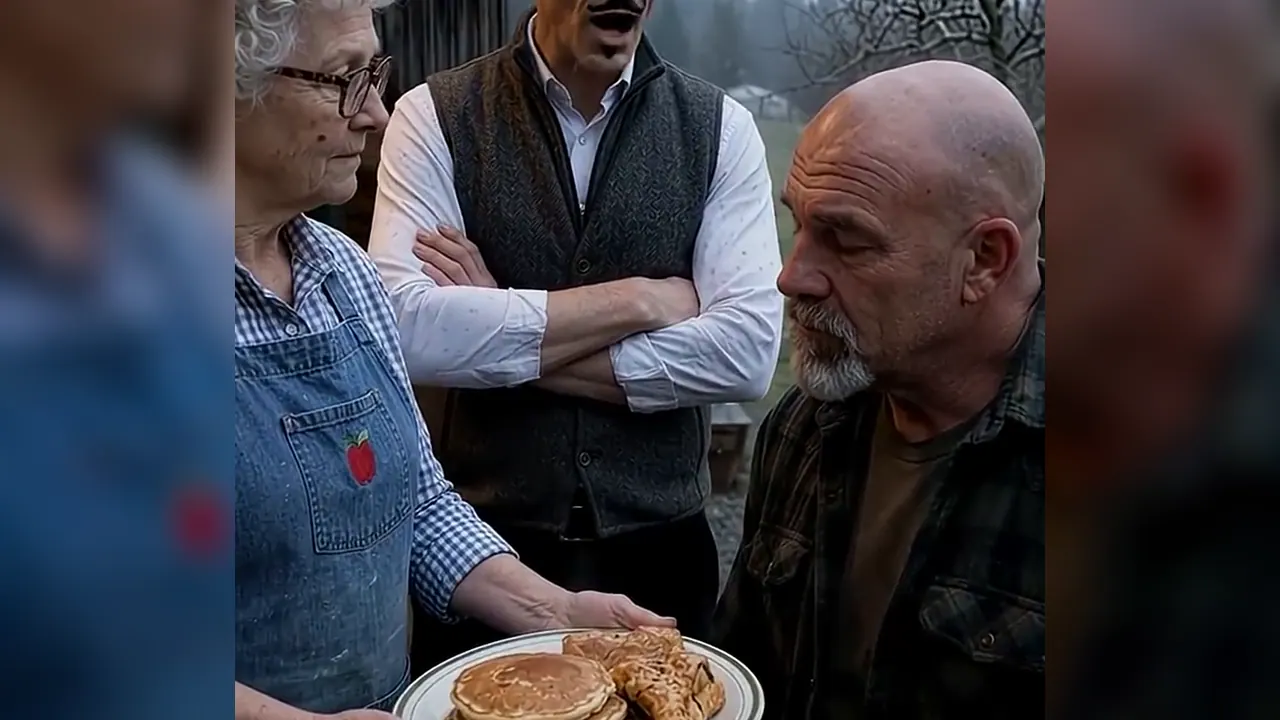
An older woman stood on the concrete platform wearing an embroidered denim apron.
She held a wide ceramic plate piled with golden pancakes and warm pastries.
Beside her sat a bearded truck driver resting on an empty wooden crate.
A man in a tailored vest watched them from the doorway with folded arms.
Suddenly, the man stepped forward and confronted the older woman about company policy.
“No free plates at my dock,” he said.
The older woman maintained her stance and gestured toward the open orchard.
“Hunger does not read your rules,” she said.
The man pulled a folded paper from his pocket and held it out.
He informed her that this paper was her final written warning.
The bearded driver stood up slowly and faced the man directly.
He remarked that he would return on Saturday to see who truly owned the barn.
The man did not reply and turned back into the building.
A Disappointing Tasting Inside the Dining Hall
Morning light filtered through the high windows of the rustic timber dining room.
Chequered tablecloths covered the round tables spaced neatly across the polished wooden floor.
A visiting beverage buyer in a dark jacket stood near the wooden serving bar.
The manager poured a pale amber liquid from a tap into a small cup.
He explained that his refined production method produced a superior commercial drink.
The buyer raised the cup, took a measured sip, and set it down.
She observed that the liquid was thin and tasted mostly like sweetened water.
She noted that traditional cider was supposed to carry real body and flavor.
The manager smiled stiffly and insisted that modern customers preferred a lighter blend.
In the adjacent kitchen doorway, the older cook watched the exchange quietly.
She tended a large copper pot bubbling slowly over an iron stove burner.
A Confrontation in the Barn Kitchen
A short time later, an assistant approached the manager inside the commercial kitchen.
She held a smartphone showing surveillance footage taken from the loading dock area.
The screen displayed the older cook handing another breakfast plate to an unseen worker.
The manager took the phone, inspected the screen, and walked toward the cooking station.
“You are finished here,” he said.
The older woman stirred her simmering copper pot with a long metal ladle.
She requested permission to finish preparing her batch of traditional spiced cider.
She noted that the visiting buyer was still waiting for an authentic tasting.
The manager rejected her request and walked back toward the dining area.
He demanded that she remove her apron and leave through the front entrance.
She extinguished the stove burner and set her ladle on the stainless steel counter.
A Public Dismissal by the Main Doors
The manager gathered the workers and visitors in the center of the wooden dining room.
He announced that standard procedures had to be upheld by every staff member.
The older woman stood calmly beside the dining tables in her blue checkered shirt.
The buyer frowned and observed that she had not come to watch public humiliation.
The older woman untied the straps of her embroidered apron without raising her voice.
She folded the dark blue denim fabric into a neat square.
She explained that she had worn that specific garment for twenty-eight years.
She placed the folded apron squarely into the manager’s open hands.
He told her that the front doors were straight ahead.
Before she could take another step, a broad figure blocked the main barn entrance.
An Unexpected Interruption at the Threshold
The bearded truck driver stood firmly across the double wooden barn doors.
“Nobody walks out of this barn today,” he said.
The manager warned the driver that he was trespassing on private business property.
He threatened to contact local law enforcement if the doorway remained obstructed.
Footsteps echoed across the wooden floorboards from the shadowed entrance corridor.
An elderly woman with gray hair stepped into the light, leaning on a dark wooden cane.
She stopped beside the front tables and looked around the quiet room.
She asked why the cook was leaving the facility without wearing her apron.
The manager immediately straightened his posture and tried to explain the rule violation.
He claimed he had acted strictly to protect the business during her absence.
The driver stated that the cook had merely shared breakfast with a hungry worker.
The Test of the Two Ciders
The cook asked the owner to sample both recipes before making any final decisions.
She brought out two earthenware cups placed side by side on a round wooden tray.
One cup held a pale yellow blend while the other contained a deep amber brew.
The buyer stepped forward and lifted the darker cup to sample its contents.
She took a slow sip and nodded approvingly at the rich aroma.
She declared that the darker liquid carried the authentic flavor of traditional heritage orchards.
The manager argued that the darker cider was merely an unrefined batch of leftovers.
The cook directed the manager to check the chest pocket of the folded apron.
He reached inside the denim slot and pulled out a laminated card.
The owner examined the card and confirmed its original signatures dating back decades.
The document legally guaranteed the cook her permanent place inside the kitchen.
A New Routine on the Loading Platform
The owner turned to the manager and relieved him of his administrative authority.
She reassigned him to loading dock duty every Friday morning at dawn.
She handed the blue denim apron back to the veteran cook.
The visiting buyer offered a retail contract placing the traditional cider across forty stores.
The cook insisted that proceeds must support the local families working the presses.
The following morning, the dawn mist gathered around the barn loading platform once again.
The former manager stood outside holding a white ceramic plate piled with fresh pancakes.
He approached the bearded driver sitting calmly on the same wooden crate.
He apologized for previously classifying the morning breakfast as unauthorized theft.
The driver smiled and accepted the warm plate without any lingering hostility.
The cook watched from the barn doorway with her hands resting comfortably.
The Meaning Behind This Country Tale
The story contrasts rigid administrative enforcement against the human value of practical hospitality.
Visual details like the embroidered apron ground the drama in daily working traditions.
Each character represents a distinct approach toward community responsibility and enterprise.
The plot demonstrates how true craftsmanship often outlasts modern shortcuts designed only for efficiency.
Resolving the conflict through an honest tasting provides a clear and satisfying turning point.
Viewers should recognize that this production is a fictional cinematic story designed for narrative entertainment.
In workplace settings, addressing personnel issues privately helps preserve professional dignity for everyone involved.
Clear written agreements protect both employees and business owners when administrative changes occur.
The man who once demanded strict compliance ends his week gladly serving breakfast himself.
Send this to someone who knows the true value of treating workers with dignity and respect.